


By Yiep Joseph
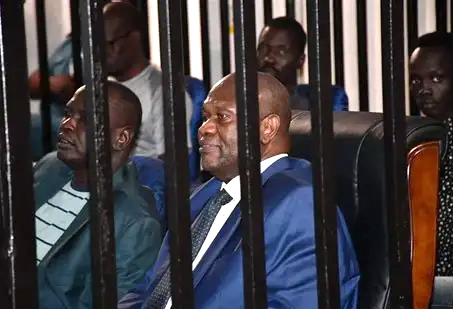
The fourth accused in the ongoing Nasir trial, Lt. Gen. Gabriel Duop Lam, has accused the leadership of the South Sudan People’s Defense Forces (SSPDF) of escalating tensions that led to clashes in Western Equatoria and in Nasir.
He made the claim on Monday during the 101st court session
Taking the witness stand, Lt. Gen. Duop recounted what he described as a chain of events that began in mid-January 2025 at Bo Bridge in Western Equatoria.
He testified that SSPDF forces unexpectedly arrived at the strategic location and ordered SPLA-IO troops to vacate the area within 12 hours, saying the deployment had been ordered by the Chief of Defence Forces as part of efforts to dismantle illegal checkpoints along the Tumbura–Wau road.
According to Lt. Gen. Duop, the order caught SPLA-IO commanders by surprise because no prior coordination had taken place through the security mechanisms established under the Revitalised Peace Agreement.
He said senior SPLA-IO officers contacted one another to verify whether the movement had been authorised, but none had prior knowledge of the deployment.
Lt. Gen. Duop told the court that he later called SSPDF Chief of Defense Forces Gen. Paul Nang seeking clarification. Rather than directly answering his questions, he said Gen. Nang referred to Bo Bridge as an old SPLA base from the liberation struggle.
Finding the response unsatisfactory, Lt. Gen. Duop said he requested a meeting with the military chief and, before the meeting, prepared a formal letter documenting what he considered ceasefire violations.
He testified that after receiving the letter, Gen. Nang convened a meeting of commanders and ordered additional SSPDF forces to deploy to Bo Bridge. Lt. Gen. Duop further alleged that the Chief of Defense Forces instructed officers to “deal with anyone” found along the Yambio-Wau main road.
Fearing an outbreak of violence, SPLA-IO forces withdrew from Bo Bridge, he said. However, he testified that SSPDF forces later attacked the new SPLA-IO positions, triggering a week of fighting that resulted in casualties and the destruction of military equipment on both sides.
He added that although SSPDF forces advanced toward Wau, SPLA-IO reinforcements later blocked the route, forcing mediation efforts involving the United Nations Mission in South Sudan (UNMISS) and the Ceasefire and Transitional Security Arrangements Monitoring and Verification Mechanism (CTSAMVM) to reopen the road.
Lt. Gen. Duop argued that the deployment of thousands of SSPDF troops, supported by artillery and aerial bombardment, violated the Permanent Ceasefire because such movements should have been coordinated through CTSAMVM, the Joint Military Ceasefire Commission (JMCC), and the Joint Defense Board (JDB).
He also alleged that shelling of civilian areas along the Sobat River undermined efforts by First Vice President Dr. Machar to ease tensions before the Nasir incident.
The accused also recounted his detention, telling the court that investigators formally notified him of the charges in August 2025 before his trial commenced on Sept. 22, 2025. He said his leg irons were removed on the day he first appeared in court.
In emotional testimony, Lt. Gen. Duop revealed that he suffered a stroke after attending a court session on Oct. 24, 2025.
He alleged that he had been denied medication for more than seven months before the medical emergency. Despite that claim, he commended National Security Service officers for arranging his immediate transfer to Nile Specialist Hospital, where he received treatment and was later visited by his family.
Responding to the charges against him, Lt. Gen. Duop denied accusations that he failed to prevent the attack on SSPDF forces in Nasir, insisting that the SPLA-IO command neither planned nor authorised any assault.
He also rejected allegations of sharing classified information with unauthorised persons.
He acknowledged speaking by telephone with U.S. Ambassador Michael Adler on Feb. 27, 2025, regarding the deteriorating security situation in Nasir and confirmed that he shared a document with the ambassador. However, he maintained that the document had already been circulated to the Troika and related to matters already raised within the framework of the revitalised peace agreement.
As Lt. Gen. Duop began explaining the legal basis for his actions under the peace agreement, the presiding judge brought the day’s proceedings to a close.
The court adjourned the trial until July 29, 2026.