


By Hou Akot Hou
Residents of Warawar Town in Baac Payam, Aweil East County, Northern Bahr el Ghazal State, are turning to village savings groups to strengthen household incomes and reduce dependence on humanitarian assistance.
The initiative is being implemented by the Christian Initiative for Restoration and Development (CIRDA), with support from Tearfund South Sudan and Tearfund Canada.
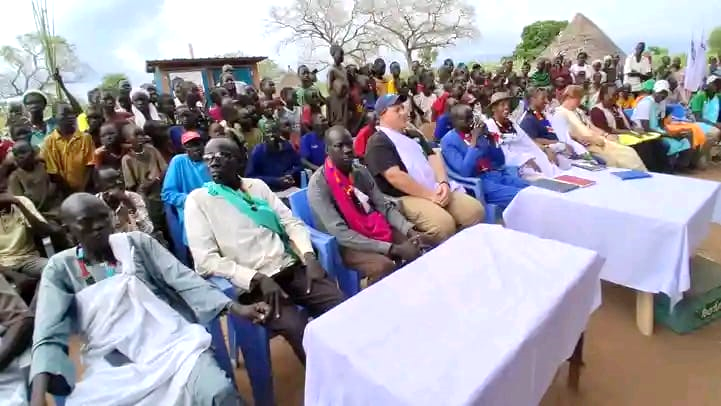
During a visit by a team of Canadian fundraisers to Warawar on Thursday, community members highlighted the benefits they have received through Village Savings and Loan Associations (VSLAs).
The savings groups allow members, particularly women, to contribute money regularly, build a common fund, and borrow from the group when they need capital for household or income-generating activities. Members later repay the loans with interest, allowing the funds to grow within the community.
Ngelo Agany Anei, a facilitator working with CIRDA, said the program had helped residents develop practical saving and financial management skills.
He said the initiative initially involved eight trained facilitators, who have since helped expand the VSLA program to 67 groups across the payam.
“We were trained by Tearfund as facilitators for CIRDA. The VSLA groups were initially eight, but those eight people have now helped reach 67 VSLA groups across the payam.”
Agany appealed for continued support to expand training and help more members understand effective saving and investment practices.
He said the benefits of community-led initiatives extend beyond household finances, pointing to the construction of a secondary school in Warawar through collective community efforts.
“Our appeal is to tell Tearfund South Sudan and Tearfund Canada to make efforts in funding such projects,” Agany said. “We have come together as a community here in Warawar and built a secondary school through our collective efforts.”
Mary Aliai, a beneficiary of one of the savings groups, said improved access to small loans had eased financial pressure on families.
She said the economic benefits were also contributing to fewer conflicts within households.
“Family conflicts have reduced,” Aliai said, explaining that greater economic stability had helped ease tensions between couples.
She added that the program had given women greater independence in managing household needs.
CIRDA Executive Officer Bishop Joseph Mamer Manot urged residents to use the initiative as a pathway toward self-reliance rather than continued dependence on humanitarian assistance.
“Our people need to shift from looking anxiously for free aid and move toward resilience and self-reliance,” Manot said.
He encouraged communities to invest in food production and other income-generating activities using the resources available to them.
The CIRDA leadership says strengthening community savings and small-scale economic activities can help households withstand financial difficulties while building local capacity.
For residents of Warawar, the growing number of savings groups represents an effort to move beyond emergency assistance and build more sustainable livelihoods through collective action.