



By Yiep Joseph
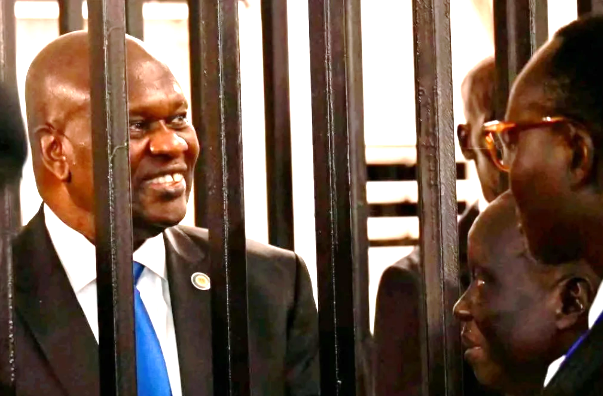
Prosecutors have defended their latest application, citing that it is intended to settle how accused persons should be examined rather than subjecting suspended First Vice President Dr. Riek Machar to different treatment.
The argument came during Friday’s 113th proceeding as the prosecution responded to objections raised by the defense over a counter-application concerning the questioning of accused persons.
Lead prosecutor Ajo Ony’Ohisa told the court that the prosecution was seeking a prospective interpretation of the law for defendants who have not yet reached the examination stage.
“The Prosecution does not seek to invalidate or reopen the examinations already completed. Neither does it seek to single out the Fifth Accused for different treatment,” Ony’Ohisa told the court.
“It asks the Court to clarify and apply the correct statutory procedure prospectively and equally to all the remaining Accused Persons.”
The dispute follows an earlier defense challenge to the proposed procedure, with lawyers arguing that the first four accused had already been allowed to present their statements before responding to questions from the court.
The prosecution, however, maintained that the issue should be determined by the statutory framework rather than by repeating a procedure it considers incorrect.
Ony’Ohisa relied on Section 197(1) of the Code of Criminal Procedure Act, 2008, which permits the court to question an accused at any stage about circumstances arising from the evidence.
He also cited Section 224(2)(e), which requires the court to question an accused generally on the case after prosecution witnesses have testified and before the accused presents a defense.
According to the prosecution, the provisions give the court an active role in ensuring that each accused has an opportunity to address matters arising from the evidence.
The defense, led by Dr. Geri Raimondo Legge, acknowledged receiving the prosecution’s counter-application but objected to the use of a rejoinder, describing it as misleading.
The prosecution rejected the suggestion that applying a different procedure to the remaining defendants would amount to unequal treatment.
“The relevant equality is equality under the law, not equality in the repetition of an error,” Ony’Ohisa said.
The prosecution asked the court to reject what it called the defense’s “erroneous interpretation” of the counter-application and direct that the remaining defendants be examined in accordance with Sections 197(1) and 224(2)(e).
Judge Stephen Simon adjourned the case until Monday, September 7, when the court is expected to rule on both applications.
The proceedings are part of the wider trial of Machar and seven co-accused over the March 2025 violence in Nasir, Upper Nile State.
The defendants face charges including treason, murder, conspiracy, terrorism, destruction of public property, and crimes against humanity.
Prosecutors allege that SPLA-IO forces and the White Army were responsible for an attack in which 257 SSPDF soldiers were killed, and military equipment worth about $58 million was destroyed or seized.
With the court now preparing to rule on the competing applications, Friday’s proceedings placed the focus firmly on how the law should govern the next stage of the trial.