


By Sabri Dibaco
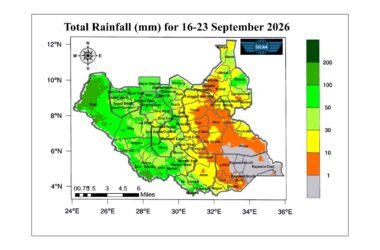
The South Sudan Meteorological Service (SSMS) has forecast moderate rainfall of between 50 and 100 millimetres in several parts of the country between November 4 and 11, 2026, while warning of extreme heat-stress conditions across most payams.
According to the weekly weather outlook released by SSMS, moderate rainfall is expected in parts of Central Equatoria, Western Equatoria, Lakes, Jonglei, Eastern Equatoria and the Pibor Administrative Area.
In Central Equatoria State, the affected areas include Terekeka, Juba, Lainya, Yei, Morobo and Kajo-Keji counties, while most counties in the western parts of Western Equatoria State are also expected to receive moderate rainfall.
The forecast further indicates that most counties in Lakes State and the southern parts of Jonglei State will experience moderate rainfall. Parts of the Pibor Administrative Area are also expected to receive similar rainfall.
In Eastern Equatoria State, the forecast identifies Kapoeta East, Kapoeta North, Budi, Ikotos, Torit and Magwi counties as areas likely to receive between 50 and 100 millimetres of rainfall.
However, light rainfall of less than 30 millimetres is expected across most other parts of the country. The meteorological service also indicates that normal wet conditions are likely to continue across much of South Sudan during the forecast period.
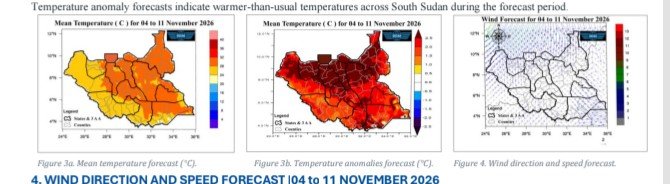
On temperatures, SSMS warned that average temperatures exceeding 28 degrees Celsius are expected across most parts of the country.
Areas likely to experience temperatures below 28 degrees Celsius include parts of Pibor Administrative Area, Eastern Equatoria, Central Equatoria and Western Equatoria states, as well as parts of Lakes, Western Bahr el Ghazal, Northern Bahr el Ghazal, Warrap and Jonglei states.
Despite the relatively lower temperatures expected in some locations, the service said temperature anomalies indicate warmer-than-usual conditions across South Sudan.
The weather outlook also forecasts light to moderate winds ranging from two to six metres per second across most parts of the country.
Winds are expected to blow predominantly from the southwest and southeast in southern areas, while northwesterly and northeasterly winds are forecast in the northern parts of the country.
SSMS has separately issued an extreme caution heat-stress alert for November 4 and 5, warning that most payams could experience elevated heat-stress conditions, particularly in the central, northern and eastern parts of South Sudan.
The service advised residents to reduce prolonged exposure to high temperatures, particularly during the hottest hours of the day, and to use shade, cooling facilities and adequate ventilation where available.
It also urged communities to drink water frequently and closely monitor vulnerable groups, including children, older persons, people with physical disabilities and expectant mothers.
The meteorological service called on relevant sectors to use the weekly forecast to strengthen preparedness and reduce potential weather-related risks.
Farmers and pastoralists are advised to use the rainfall outlook when planning agricultural activities, livestock movements, pasture monitoring and water-resource management.
The transport and infrastructure sector was urged to monitor the effects of rainfall on roads, bridges and other infrastructure, particularly in flood-prone and low-lying areas, to minimise possible transport disruptions.
In the health sector, SSMS recommended strengthening public awareness, ensuring access to safe drinking water and proper sanitation, and monitoring potential waterborne diseases associated with rainfall.
The service also called on disaster risk management authorities and emergency responders to strengthen early-warning dissemination, monitor updated forecasts and improve preparedness for possible localised flooding and other weather-related hazards.
SSMS said its weekly weather outlook is intended to support short-term planning and decision-making in agriculture, transportation, health and emergency response, while helping communities prepare for changing weather conditions.