

By Yiep Joseph
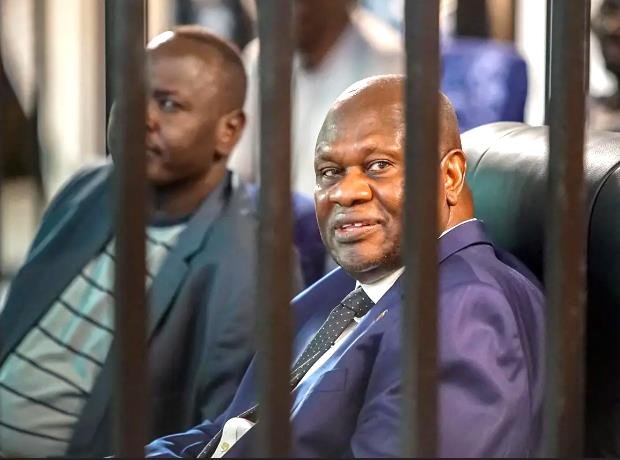
The former First Vice President, Dr Riek Machar, has told the court that disagreements over force deployment disrupted plans to rotate SSPDF troops in Nasir before the March 2025 violence.
Machar claimed the Joint Defence Board (JDB) had approved replacing the government troops with Necessary Unified Forces, but the arrangement was later affected by disagreements within the military leadership.
He revealed this during his examination at the 129th court session on Wednesday, November 18, 2026, as he continued presenting his account of the security decisions preceding the violence in Nasir County, Upper Nile State.
According to Machar, the JDB had recommended the replacement after concerns that SSPDF soldiers had overstayed their deployment in Nasir.
He told the court that some soldiers were reportedly deserting in small groups and threatening to abandon their positions, potentially leaving behind heavy military equipment.
Machar explained that the original rotation plans involved deploying at least 750 troops drawn from cantonment sites in Unity State, Greater Fangak, Wunlit and Nyakeen.
The troops were expected to undergo training before being deployed to replace the SSPDF forces already stationed in Nasir.
However, Machar said disagreements emerged when he learned that the forces being prepared for deployment would consist exclusively of SSPDF soldiers rather than the agreed Necessary Unified Forces.
He testified that he raised the matter with General Paul Nang, the then CDF, who maintained that Nasir belonged to the government and that only SSPDF troops would be deployed.
According to Machar, General Nang described the agreement as “a deception” during their discussion.
Machar said he insisted that the military leadership respect the JDB decision and later informed General Gabriel Duop Lam, then Deputy Chief of Defence Forces and co-chair of the JDB, about the disagreement.
He said he urged Gabriel to follow up on arrangements to withdraw an SSPDF battalion from northern Upper Nile and send it to Nasir to replace the troops that had overstayed their deployment.
Machar further told the court that although a battalion of Necessary Unified Forces was withdrawn and sent to Malakal, it was ultimately not included in the forces deployed to Nasir.
The issue remained unresolved into February 2025, when members of parliament representing Nasir and Ulang counties visited Machar’s office to discuss the planned deployment.
He said he intended to request a two-week delay from the president to allow local leaders to consult residents and encourage them to welcome the incoming forces.
According to Machar, communities in the two counties were concerned that the incoming troops, including forces associated with Abushok and Agwelek, might disarm them.
He told the court that he subsequently wrote to the President on February 20, 2025, requesting additional time for local leaders to engage the population.
However, Machar said he received no response to the letter, meaning the planned consultations with community leaders did not take place.
He also described efforts by government officials, traditional leaders and parliamentarians to reduce tensions in the Sobat corridor through peace messages and community engagement.
These efforts included encouraging Upper Nile Governor James Othon Oya to visit Nasir and Ulang counties to promote peaceful relations and consolidate stability.
Machar’s testimony forms part of the ongoing trial examining the circumstances and security decisions surrounding the February 2025 violence in Nasir.
The proceedings are expected to continue on November 23, 2026, following the adjournment of the 129th session.