


By Yiep Joseph
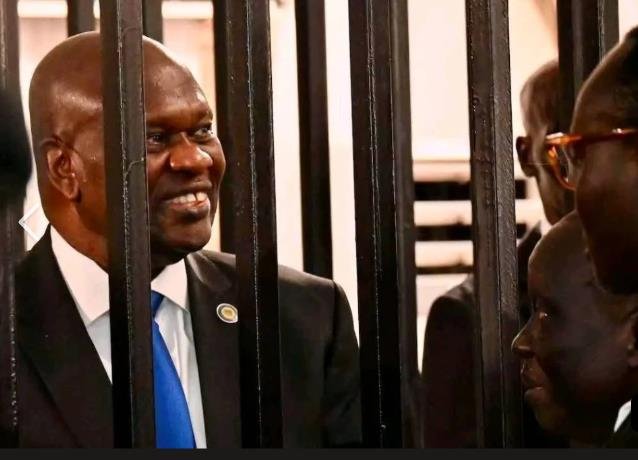
Former First Vice President Dr Riek Machar has told a Special Court in Juba that he made several attempts to secure the peaceful reception of government forces deployed to Nasir in February 2025, but the initiative collapsed after the gunboats returned to Malakal.
Machar made the revelations on Monday while presenting his eighth defence statement during the 130th session of the trial at Freedom Hall in Juba.
In his testimony, Machar described how he engaged senior military commanders, government officials, county commissioners, traditional chiefs and youth representatives in efforts to prevent further fighting in Nasir and neighbouring Ulang County.
He told the court that disagreements between then Chief of Defence Forces Gen. Paul Nang and Lt. Gen. Gabriel Duop over troop deployment and the dismantling of military checkpoints had weakened coordination within the security sector.
Machar further alleged that the disagreements paralysed the Joint Defence Board, which he said had failed to function effectively during Nang’s tenure.
Turning to events in Upper Nile State, Machar told the court that government gunboats began moving towards Nasir on February 17, 2025, before departing Khor Fulus on February 21.
He said the movement coincided with helicopter bombardments of villages in Nasir, Ulang, Nyirol and Akobo counties, as well as shelling along the Sobat River.
According to his testimony, clashes between government forces and local youth occurred at Nyathor in Ulang County on February 26, triggering further concerns over civilian safety and displacement.
Machar said he subsequently consulted former Petroleum Minister Puot Kang Chol before contacting then Upper Nile Governor James Odhok Oyai and the commissioners of Nasir and Ulang to discuss ways of de-escalating the situation.
During the consultations, he proposed that local communities welcome the incoming government forces to allow the deployment and troop rotation to proceed without further confrontation.
However, he told the court that the commissioners reported facing resistance from some youth, who allegedly threatened them and accused them of betraying their communities.
Machar said he then organised telephone conferences involving paramount chiefs, elders and youth leaders from both counties to present his proposal directly.
According to him, the community representatives agreed to establish reception committees to welcome the troops but demanded that helicopter bombardments and shelling by gunboats stop.
He said he accepted the request and contacted Lt. Gen. James Koang Chuol Ranley to communicate the demand. He also issued a written directive establishing reception committees in Nasir and Ulang.
The planned reception, however, encountered logistical challenges when the advancing gunboats became stranded in shallow waters near Malual Junction.
Machar told the court that he later coordinated with Gen. Nang and local officials to arrange six large transport boats to carry troops and their supplies. He said Nang agreed to provide $60,000 for the arrangement.
However, the alternative plan was abandoned after the gunboat commander decided to return to Malakal, despite assurances from local officials that the communities were prepared to receive the forces, according to Machar.
He further told the court that by March 2, 2025, youth from several sections of Nasir had returned to their villages.
Machar also recounted an extended presidency meeting held on March 3, during which the security situation in Nasir and Ulang was discussed. He said the meeting adopted resolutions calling for de-escalation, continued engagement with youth and the convening of the National Security Council.
The court adjourned the proceedings until Wednesday, November 25, when Machar is expected to continue presenting his defence.