



By Yiep Joseph
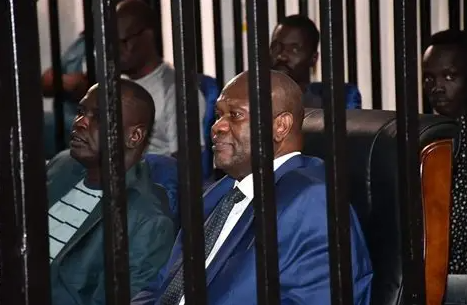
The fourth accused in the Nasir incident trial, Gabriel Duop Lam, has denied allegations that the SPLA-IO was involved in the clashes between local youth and the South Sudan People’s Defence Forces (SSPDF) in Nasir County.
He told the Special Court that he and the SPLM/A-IO leadership instead played a constructive role aimed at preventing violence.
Testifying during the 99th session of the Special Court, Gabriel Duop Lam rejected claims linking the Sudan People’s Liberation Army-in-Opposition (SPLA-IO) to the fighting, maintaining that the clashes were not orchestrated by the opposition movement.
During his examination, Lam told the court that he worked to resolve misunderstandings between local armed youth, commonly known as the White Army, and SSPDF forces stationed in Nasir.
The accused No. 4 denied the involvement of SPLA-IO in the Nasir Incident, citing that he told the investigation committee when he was investigated.
“The second point I raised to [the] investigation committee is that the fighting in Nasir between the SSPDF and the local youth was not planned, not designed, [and] not operationally executed by the SPLA-IO commanders; both had strategic, operational, and tactical levels, contrary to what is being propagated and circulated on social media,” he said.
He said his efforts were aimed at promoting dialogue and easing tensions to prevent the situation from escalating into violence.
The court heard that Lam’s engagement focused on encouraging communication between the parties in an attempt to restore calm amid growing mistrust in the area.
He maintained that his actions were intended to support peace rather than contribute to the conflict.
After several hours of proceedings, the presiding judge, Dr. James Alala Deng, adjourned the hearing to Friday, July 24, 2026, when the fourth accused is expected to continue with his examination before the court.
The Special Court has been hearing evidence from several accused persons in connection with the Nasir incident, which led to deadly clashes in Upper Nile State. The trial is examining the circumstances surrounding the violence and the alleged roles of the individuals facing charges.
The Special Court was established by the Judiciary of South Sudan to hear cases arising from serious security incidents that have attracted significant national attention.
The court is mandated to ensure that those accused of criminal offenses receive a fair trial in accordance with South Sudanese law while allowing the prosecution and defense to present their evidence before an independent bench.
The Nasir case has become one of the country’s most closely watched judicial proceedings because of its implications for security, accountability, and stability in Upper Nile State.
The ongoing trial is expected to determine individual criminal responsibility based on the evidence presented in court, with the judges expected to issue their verdict only after hearing testimony from all witnesses and completing the examination of the accused persons.