

By Sabri Dibaco
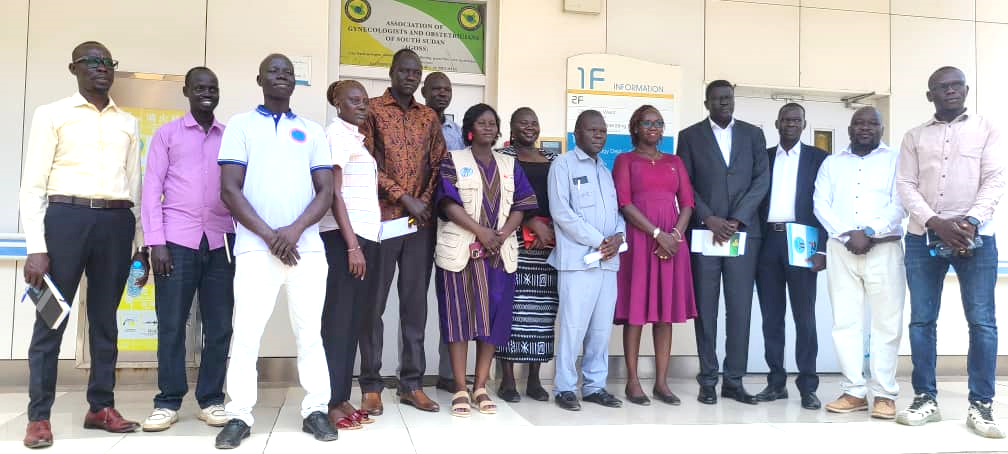
The Association of Gynaecologists and Obstetricians of South Sudan (AGOSS) has handed over maternal and newborn health training simulators to Juba Teaching Hospital (JTH) in an effort to strengthen the practical skills of midwives, nurses, and reproductive health workers.
The handover ceremony in Juba brought together officials from the National Ministry of Health, Juba Teaching Hospital, the South Sudan Nurses and Midwives Association (SSNAMA), the Association for Media Development in South Sudan (AMDISS), and development partners including the Canadian Embassy, the World Health Organisation (WHO), and the United Nations Population Fund (UNFPA).
The simulators are expected to provide health workers with practical training opportunities and improve their ability to deliver quality maternal and newborn healthcare services.
Speaking during the handover, Director General for Reproductive Health at the Ministry of Health, Dr. Michael Mading, said the equipment would strengthen the practical capacity of health workers and contribute to improving reproductive health services.
Mading urged Juba Teaching Hospital to ensure the equipment is properly utilised and that the knowledge gained through the training reaches health facilities beyond Juba.
He said the Ministry of Health would continue working with AGOSS and other partners to address challenges affecting the country’s healthcare system.
Juba Teaching Hospital Director General Anthony Lupia Simon described the donation as an important contribution to improving healthcare services in South Sudan.
Lupia said the equipment had arrived at an important time when health workers require continuous practical training to improve the quality of services provided to patients.
He encouraged reproductive health workers to actively participate in the training and apply the knowledge gained in serving communities across the country.
The President of AGOSS, Dr. Idyoro Ojukwu, reaffirmed the association’s commitment to supporting South Sudan’s health sector through the provision of essential equipment and technical support.
Ojukwu thanked the organisations and development partners that contributed to the initiative, saying AGOSS would continue working with Juba Teaching Hospital and other stakeholders to strengthen the country’s healthcare system.
Meanwhile, Dr. Alfred Nicola, Head of the Department of Obstetrics and Gynaecology at Juba Teaching Hospital, welcomed the equipment and called for greater public awareness of maternal and newborn health services.
Nicola also appealed to the Ministry of Health and development partners to provide additional modern medical equipment and essential medicines to the hospital.
He said strengthening healthcare services within South Sudan could help reduce the number of patients travelling abroad in search of medical treatment.
SSNAMA President Repent Khamis George said the health sector remains one of the major challenges facing communities across South Sudan due to gaps in healthcare services, equipment and other resources.
Khamis reaffirmed the association’s commitment to working with the government and development partners to address challenges affecting nurses, midwives and the wider health workforce.
The role of the media in promoting public awareness of health issues was also highlighted during the event.
AMDISS Director Ayaa Irene emphasised the importance of using radio, television, and digital platforms to educate the public about maternal and newborn health.
She called for stronger collaboration between AGOSS, AMDISS, and other health-sector stakeholders, including opportunities to train journalists in specialised health reporting.
The handover is part of broader efforts by the Ministry of Health, AGOSS, Juba Teaching Hospital, UNFPA, WHO and other partners to strengthen maternal and newborn healthcare and improve the capacity of reproductive health workers in South Sudan.
The initiative is expected to provide health professionals with practical training while supporting efforts to improve the quality of maternal and newborn services delivered to communities across the country.