

By Sabri Dibaco
Traditional leaders in Central Equatoria State have been urged to use their customary authority to prevent child marriage, keep girls in school, and turn previous commitments into concrete action at the community level.
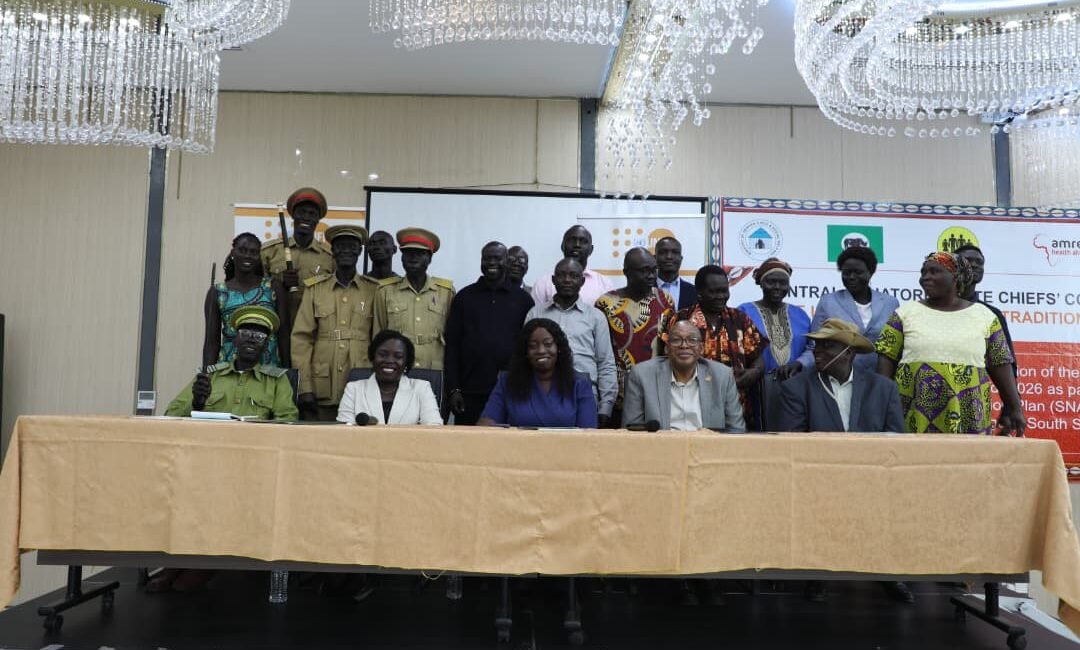
The call was made during a state-level chiefs’ conference on ending child marriage and other harmful practices, attended by government officials, chiefs, religious leaders, development partners, civil society representatives, youth champions, and the media.
The conference is being led by the Central Equatoria State Ministry of Gender, Child and Social Welfare, with support from the United Nations Population Fund (UNFPA) and other partners.
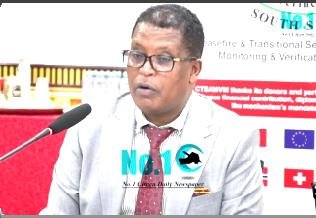
Innocent Modisaotsile, Officer-in-Charge and Representative a.i. of the UNFPA South Sudan Country Office, said child marriage remains a major concern in South Sudan, where an estimated 40 per cent of children are married before reaching the age of 18.
He said the figure is approximately twice the global average.
“Behind each of these numbers, there is a girl who has been denied education, there is a girl who has been denied health, and there is a girl who has been denied [the chance] to dream about what she wants to be,” Modisaotsile said.
He said child marriage also deprives communities and the country of the educational and economic contribution girls could make if given opportunities.
Modisaotsile said chiefs are central to efforts to end child marriage because of their influence over culture, customary justice, and community decision-making.
He identified four key areas where traditional leaders can contribute: promoting positive cultural norms, empowering girls, strengthening local justice mechanisms, and connecting vulnerable children to protection and care services.
“Through your leadership, the enactment and enforcement of local customary bylaws across every payam and boma can transform the national policies into real protection on the ground,” he said.
He also called on chiefs to engage men and boys, encourage families to keep girls in school, and work with social workers, protection partners, and law enforcement agencies.
He identified Terekeka, Lainya, and Yei as areas requiring particular attention in community awareness and prevention activities.
UNFPA also pledged continued support for strengthening local bylaws, expanding safe spaces and school clubs, and improving coordination among stakeholders.
Adeng Andrew Leek, undersecretary in the National Ministry of Gender, Child, and Social Welfare, shared her personal experience of nearly being married off as a child.
Leek said she lost her father when she was about two and a half years old and was raised by her mother, who became a widow at the age of 34.
She said she later discovered that arrangements had been made for her to marry a much older man.
“She was supposed to marry me to a man who was 45 years old by then,” Leek recounted.
Leek credited her mother for protecting her future and ensuring that she received an education.
“She is the one who raised me. She is the one who educated me,” she said.
She said her experience demonstrated the importance of protecting girls from early marriage and allowing them to remain in school.
Leek urged chiefs to recognise their influence over cultural practices and use their authority to protect children.
She said traditional institutions have historically played an important role in resolving disputes and making decisions within communities.
“The decision that will end child marriage in South Sudan will not be made first in offices in Juba. They will be made under those trees by the people in this room,” she said.
Leek encouraged communities to recognise that culture can change while retaining positive values.
“Culture is not a stone that cannot be moved. Culture is a river,” she said.
She also recognised chiefs who have previously intervened in cases where families attempted to arrange marriages for underage girls, saying such actions show that traditional authority can be used to protect children.
Leek called on traditional leaders to review resolutions adopted in 2022 on ending child marriage and assess what had been achieved and what had failed.
“A plan that hides its failures cannot fix them,” she said.
She urged each county to develop and sign a 2026 action plan during the conference, saying the commitments should be measurable and open to community monitoring.
“Let that signature carry the weight it has always carried, a promise the whole community can hold you to,” Leek said.
She urged chiefs to judge the success of their work by actual improvements in the lives of girls rather than the number of conferences or resolutions held.
“History will not count our conferences. It will ask whether a girl in Lainya finished school, chose her own husband, and raised children who did the same,” she said.
Caretaker Governor of Central Equatoria State, General Agustino Jadalla Kamilo Wani, also called for practical measures to accompany commitments made at the conference.
His speech was delivered on his behalf by Nunu Diana Alison, Director General in the State Ministry of Gender, Child, and Social Welfare.
The governor described chiefs as important custodians of culture, community values, social order, and traditional justice.
“Our chiefs occupy a unique position in our communities. They are custodians of our culture, community values, social order, and traditional justice,” the governor said.
He urged traditional leaders to use their influence to protect children’s dignity, rights, and future while promoting cultural practices that safeguard children.
The governor said child marriage should not be treated only as a family matter because of its impact on education, health, economic opportunities, and community development.
“Protecting our girls therefore means protecting the future of the Central Equatoria State and South Sudan as a whole,” he said.
He called for stronger cooperation between chiefs, parents, religious leaders, and government institutions to encourage girls to remain in school and strengthen reporting and response mechanisms for child marriage and other forms of abuse.
“Ending child marriage requires a collective responsibility. Government alone cannot achieve it,” he said.
The conference is expected to produce county-level commitments and 2026 action plans aimed at strengthening local protection mechanisms, preventing child marriage, supporting girls’ education, and improving accountability.
The organisers say the key test will now be whether the commitments made by traditional leaders are translated into measurable action in communities across Central Equatoria State.