

By Chol D. Johnson
The Minister of General Education and Instruction (MoGEI) has pledged the Ministry’s commitment to the promotion of the space science objectives in the country.
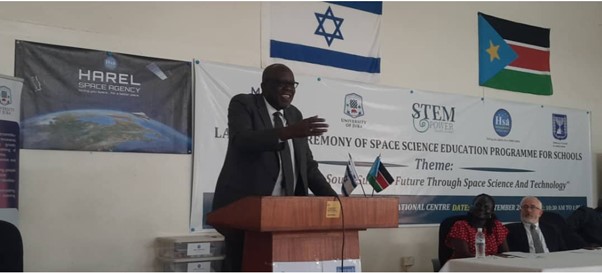
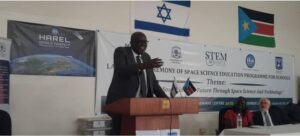
Kuyok Abol Kuyok, South Sudan’s Minister of Education, made the pledge at the launch of the Space Science Education Programmes for schools on Wednesday at University of Juba’s STEM and vocational center on Wednesday.
“This is a very important initiative that marks a significant milestone in South Sudan’s journey toward fostering a knowledge-based society, unlocking the unlimited potential of our youth,” Abol said.
Abol emphasized that the initiative aligns with the government’s approach to education, following the directive of the President of South Sudan, which reaffirmed the government’s commitment to ensuring that the education sector is improved.
The launch of South Sudan’s first-ever Space Science Education Program was initiated by Mayardit Academy for Space Science at the University of Juba.
The event brought together over two thousand participants from a wide-ranging spectrum, including government officials, stakeholders, and students.
Minister Abol revealed that the President had directed the Minister of Higher Education to introduce innovative literacy initiatives aimed at revitalizing the quality of education in the country.
Among these efforts is the launch of a Space Science Education Program, which can potentially revolutionize how science is taught in schools by sparking curiosity to inspire the next generation of scientists and engineers.
“Through this initiative, we are empowering our youth to become agents of social progress and economic growth by aligning the program with the goals of a child-centered and confidence-based curriculum that nurtures creativity and critical thinking” he said.
Both the Ministry of General Education and the Ministry of Higher Education are dedicated to integrating space science education into the national curriculum and university programs.
“We believe that understanding the cosmos and the scientific principles behind it can unlock new pathways for innovation and development in South Sudan,” Abol concluded.
Ambassador Wol Arich, representing the Ministry of Foreign Affairs and International Cooperation, shared his optimism:
“I’m happy to see the future in our youth. We are free people, and a free man or woman should pursue what brings them joy. You have raised your flag; now you can shape your own future,” he remarked.
He further stated that South Sudan’s space is not limited, and with close collaboration and support from international partners, including the Israeli Embassy and Ambassador Gershon Kedar, with whom the country shares a long-standing relationship, South Sudan is entering a new phase of collaboration to empower youth across the nation.
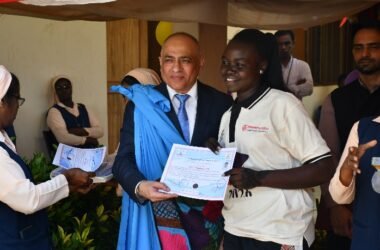
A representative of STEM power and the Space Science Program, science student Sarah Moses Gatkuoth expressed her delight and optimism in the program.
“This is a dream come true for South Sudan. We have imagined space science education would reach South Sudan, but with committed and educated people, we are going to achieve more,” she said.
“On behalf of all students, especially girls, I want to say that joining science is not about gender; it’s about passion and willingness to participate” she added
Furthermore, she underlined everyone who has ever been underestimated: “you are capable of great things. Let’s join hands and help space science grow in South Sudan.” She stated