


By Kei Emmanuel Duku
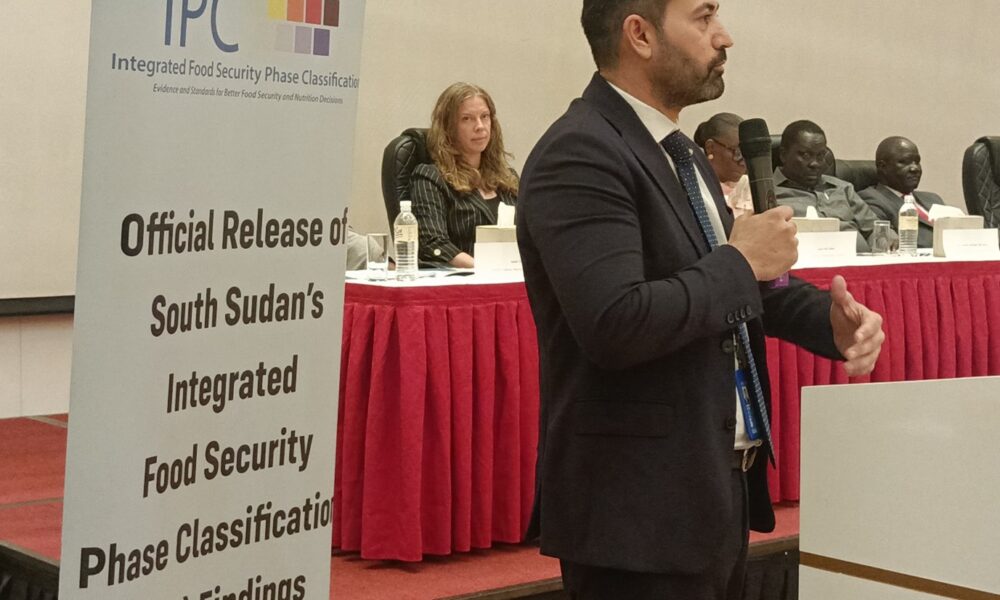
With six million lives on the line, the devastating food crisis in South Sudan hit center stage as the latest IPC report was launched. Top humanitarian officials didn’t mince words, delivering a stark and urgent demand for the government to move past mere promises and immediately fund critical sectors like agriculture.
Peggity Pollard-Davey, the Foreign, Commonwealth & Development Office (FCDO) Humanitarian Advisor for South Sudan, stressed that international assistance alone can never meet all needs and aspirations of the local population as such that the government should fulfill its financial commitments.
Pollard-Davey was unequivocal in her demand for greater government accountability and investment. “Government must assume greater responsibility for meeting citizens’ needs,” she stated. “It must honor commitments to fund basic services through executing approved budgets for sectors including agriculture, health, nutrition, education and social protection.”
The advisor highlighted that South Sudan is fertile and has opportunities for citizens to sustain themselves, but this requires stability for this potential to be achieved.
She further noted that key investments in infrastructure are also missing and government must invest in basic road and river infrastructure which would support the markets and the trade that many of its citizens currently lacks
The FCDO official warned that the new IPC report sounds a loud “alarm bell” for the nearly six million South Sudanese already classified as being in a food crisis (IPC Phase 3 and above).
She added that five counties across the country now face the most critical malnutrition conditions, up from just one county in 2024. Conflict, she noted, is a major exacerbating factor where the country registered 25% increase in access incidents and over 50 incidents of violence against aid workers in less than a year.
This she said is a clear worsening of the situation and called for an end to violence against aid workers because unhindered access or safe movements of civilians and aid workers allow easy access to humanitarian assistance.
“In nearly every case where there has been violence, things have got worse, we have already gone past the point where this alarm started to ring,” she said, expressing deep concern over deteriorating malnutrition trends where a staggering 70% of reported malnutrition cases are concentrated in Jonglei, Northern Bahr el Ghazal, Upper Nile, Unity, and Warrap states.
Pollard-Davey welcomed existing plans and policies outline the government however, she reiterated the core message: “Change is possible, but peace is the foundation for that improvement… the government must act on commitments. Commitments to transparent public financial management.”
Meanwhile, Adham Effendi, World Food Program (WFP) Deputy Country Director in South Sudan, acknowledged some small victories food crisis situation in the country but stressed that the overall situation remains dire.
He explained that in some parts of the country, there have been a slight reduction in the severity of food insecurity, which is definitely a positive outcome, however, there is need for collective role for those countries to backslide to food crisis. “These improvements are fragile and must be protected through sustained timely actions and investments,” said Effendi.
The WFP official welcomed the government’s Food Security Crisis Preparedness National Framework designed to mitigate shocks. However, he warned that the positive news should not overshadow the harsh reality.
According to the humanitarian expert South Sudan remains among the largest and most severe food crisis in the region with 53% of the population projected to be in IPC Phase 3 and above for the 2026 lean season and the country also has the second-largest prevalence of food insecurity in the globally.
Effendi highlighted that the collective multi-sectoral response has shown results, noting that Malakal, Pibor, and Ulang counties are no longer projected to face catastrophic hunger (IPC Phase 5) in 2026. “This suggests that we can avert catastrophic hunger and risk of famine,” he said.
However, the risk of deterioration remains high if support is withdrawn, underscoring the need for sustained multi-sectoral support. Effendi also echoed the link between stability and progress.
“In counties where peace has held and no additional shocks occurred, we see meaningful improvement,” he concluded. “The message is clear, peace enables progress towards eradicating hunger.”