



By Kei Emmanuel Duku
In a major push for accountability, the government yesterday moved to ban individuals with criminal records or corrupt interests from holding valuable mining licenses, signaling an end to the “business as usual” approach that has plagued the nation’s resource management.
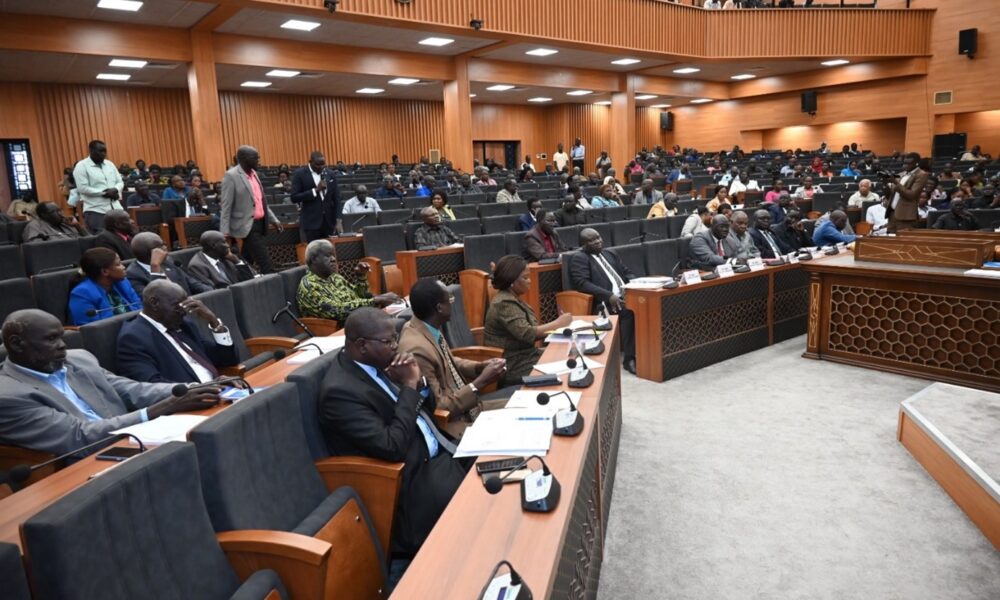
These powerful integrity measures, designed to purge the sector of vested interests, were officially presented to the Transitional National Legislative Assembly by Dr. Joseph Geng Akech, the Minister of Justice and Constitutional Affairs, as part of comprehensive amendments to the 2012 Mining Act.
The most impactful provision in the proposed legislation is its surgical move to overhaul the licensing process. The bill proposes to bar individuals who have been convicted of relevant crimes alongside government officials found to have personal stakes in the industry from holding critical permits such as large-scale, exploration, or reconnaissance licenses.
This core measure, the Minister explained, is designed to restore public faith in the multi-billion-dollar sector and forms part of a wider effort to professionalize resource management. Dr. Akech emphasized that the amendment is carefully structured to secure the nation’s future mineral wealth.
The bill’s framework establishes a robust, centrally-controlled licensing structure. The proposed law empowers the Minister responsible for mining to declare specific strategic minerals in consultation with relevant stakeholders. Furthermore, the legislation explicitly provides for the various tiers of mining licenses, including the large-scale mining license, the exploration license, and the reconnaissance license.
The senior legal official noted that under the new rules, the Minister for Mining is empowered to authorize all operational licenses from trading and retention to exploration and small-scale mining based on the advice of the Undersecretary. The bill also introduces new provisions clarifying the functions and duties of that Undersecretary position.
To support this new era of oversight, the amendment mandates the establishment of three key institutions. The Justice and Constitutional Affairs Minister explained that the bill creates the South Sudan Geological Survey Agency to proactively search for mineralized areas using geo-scientific methods, providing crucial advice to the Mining Authority.
Additionally, another part of the bill details the creation of the South Sudan Mining Corporation, which will serve as the government’s official investment arm, tasked with generating revenue and engaging in capacity building activities by partnering with mining and exploration companies.
Once the bill goes through the necessary legislative standards, high standards of governance will be expected from all institutional leaders. The new proposed law requires that all board members, directors, and senior employees of the authority must declare their assets and liabilities, including those of their spouses and children, in accordance with applicable law.
The legislation outlines clear, competitive procedures for appointing and managing these bodies. The Boards of Directors for both the Mining Authority and the Mining Corporation will be appointed by the President upon the Minister’s recommendation.
Following this, the boards will then competitively recruit the Managing Director or Director General, with final appointment resting with the President.
“We are ensuring that every appointment is merit-based,” Dr. Akech said. “The amendments also empower the boards to recruit staff and determine their conditions of service in consultation with the salaries and remuneration commission.”
Furthermore, the new rules mandate that authorities must prepare annual reports detailing their activities during each financial year and submit these to the President and the Assembly through the relevant Minister.
Dr. Akech confirmed that the bill is not simply a regulatory upgrade but is directly driven by the 2018 peace agreement.
The bill’s initial provision emphasizes that all mineral resources belong to the people of South Sudan and that the national and state governments shall act as custodians on their behalf.
The legislation further outlines the general principles governing mining and mineral development, such as the conservation and development of mineral resources for the benefit of the present and future generations, alongside the strict adherence to safety, health, and environmental standards during exploitation.
The comprehensive bill, titled the Mining Act 2012 Amendment Bill 2025, consists of 84 amendment sections, affecting 26 sections of the principal Act and adding two new thematic provisions.
Following the presentation, the bill was referred to the Committee on Natural Resources at the Transitional National Legislative Assembly. The committee has been tasked with the significant responsibility of reviewing the document and reporting back to the August House within 14 days.