

By Lodu William Odiya/Alan Clement
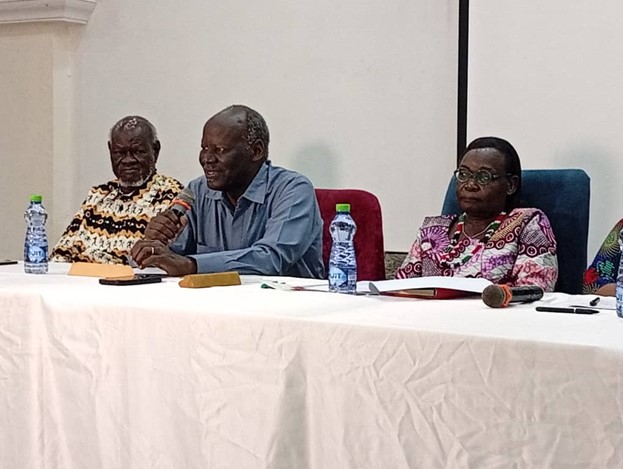
Chairperson of the National Democratic Movement (NDM), Dr. Lam Akol, urged South Sudanese and leaders in particular to be honest in the implementation of the peace agreement.
He expressed that people should acknowledge the failures of the Revitalized Agreement on the Resolution of the Conflict in South Sudan (R-ARCSS) and develop ways to go forward.
The remark came yesterday during stakeholder’s dialogue as he cautioned that repeated postponements of elections and prolonged transitional governance risked repeating past mistakes.
“Let us be honest with ourselves. R-ARCSS was supposed not only to resolve the war’s consequences but also to create trust, confidence, and collegial action among the parties. Eight years later, are the parties more confident? Are they working together as expected? I don’t think so,” Akol said
“If God gives us a longer life, you may come here in 2027 to talk about how elections should be conducted in 2028,” he added,
He underscored the urgency of inclusive dialogue involving all South Sudanese.
Leaders, citizens, and youth demanded honesty, unity, and decisive action to end cycles of conflict and stalled governance.
On her part, Mary Apayi, 2nd Deputy Chairperson of the SPLM, echoed the frustration of citizens weary of endless transitions.
“We are tired of transition over transition. People want democracy; they want to select their leaders,” she said.
Apayi stressed that political differences must never overshadow South Sudanese identity, calling for completion of the peace agreement, civic education, and a permanent constitution as foundations for sustainable democracy.
“Peacebuilding is a shared responsibility and must be locally owned. We need to put our country first,” she emphasized.
Meanwhile, Dr. Angelina Bazugba, Director National Transformational Leadership Institute (NTLI) shifted focus to the economic dimension of recovery. She highlighted the paradox of South Sudan’s abundant resources remaining underutilized.
“We are importing milk, beef, and fish from Uganda despite having 30 million cattle. The resources we have are not yet economic resources,” she said.
Bazugba argued that transforming natural wealth into economic assets is key to empowerment, particularly for women and youth.
She urged investment in infrastructure, reliable energy, health services, and market access to enable citizens to actively contribute to development.
Providing historical perspective, Professor Adwok Nyaba reflected on decades of conflict and missed opportunities.
“The war was fought without clear ideas of what we wanted to be,” he said.
“Today, we must ask ourselves where we went wrong and how to restore the social capital that once united our people,” added Professor Adwok.
Furthermore, Nyaba linked the failure to achieve national aspirations to leadership shortcomings, noting that South Sudan’s rich endowment of natural resources has yet to translate into social, economic, or political cohesion.
Florence Agiba, speaking for South Sudanese youth, contrasted the ambition of the younger generation with the caution of older leaders.
“Young people are full of energy, ideas, and the drive to transform South Sudan. Yet our voices are not being heard, and we are often excluded from decision-making tables,” she said.
Agiba demanded equitable youth participation in governance, transitional justice, and socio-economic development.
“Young people are not just the future; they are essential partners today,” she declared.
The dialogue underscored cross-cutting challenges that continue to undermine peace and governance.
Participants highlighted the need for a unified professional army, completion of the peace agreement, functional democratic institutions, equitable inclusion of youth and women, and civic education to strengthen national cohesion.
Speakers agreed that South Sudan’s political space remains fragile, with trust between parties low and implementation of agreements uneven.
Without addressing these structural issues, the country risks continued instability and stagnation.
The speakers closed with a unified call for dialogue, inclusion, and honest reflection.
“Our political differences should not overshadow our common identity. Only together can we build a peaceful, democratic, and prosperous South Sudan,” Apayi said.
The third day of the Stakeholders’ Dialogue made clear that citizens, leaders, and youth are aligned in their vision.
South Sudan must prioritize peace, social cohesion, and democratic participation, turning decades of struggle into tangible progress.