


By Alan Clement
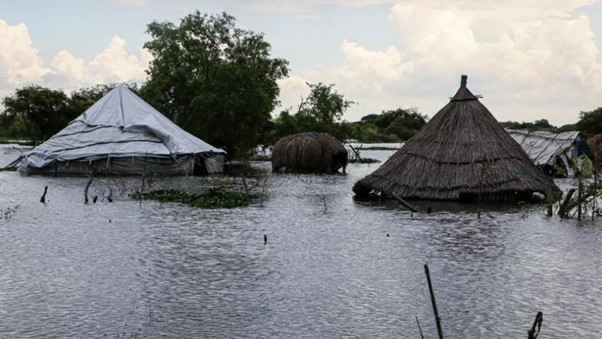
South Sudan emerged as one of the countries most severely affected by flooding as climate-driven water crises intensify worldwide, according to the 2025 Report of the UN Secretary-General on the Work of the Organization.
The report notes that nearly four billion people globally are affected by water stress, with fragile and conflict-affected states bearing the heaviest burden underscoring how climate shocks, conflict and weak infrastructure are driving mass displacement and humanitarian need.
The country has experienced consecutive years of above-average rainfall which caused the Nile and its tributaries to swell and consequently inundating vast low-lying areas.
UN agencies estimate that flooding has affected millions of South Sudanese since 2019, destroying homes, roads and farmland, and compounding food insecurity in a nation already struggling with economic fragility and political instability.
According to data cited by the UN, 2024 was a record-breaking year for disaster-related displacement, with nearly 46 million people worldwide forced from their homes, largely due to floods and storms
South Sudan remains among the most flood-prone countries in East Africa, with entire communities displaced for months at a time.
“The world is facing a global water crisis that threatens peace, development and human rights,” Secretary-General António Guterres said in the report, warning that climate-driven disasters are striking hardest in countries least equipped to cope
In South Sudan, floodwaters have submerged grazing land and crops, eroding livelihoods in a population where more than 70 per cent rely on subsistence agriculture.
The humanitarian consequences are severe. The UN report cited that South Sudan required $1.4 billion in humanitarian funding in 2024, but only 54 per cent of that amount was funded, forcing aid agencies to scale back life-saving assistance
Floods have also increased the risk of waterborne diseases, disrupted education and restricted access to health services in remote areas.
Tom Fletcher, the UN Under-Secretary-General for Humanitarian Affairs, said climate shocks are overwhelming an already stretched humanitarian system.
“We must act with unity, innovation and urgency to deliver aid to those in greatest need,” he said, pointing to flood-affected countries such as South Sudan where early warning and preparedness remain limited
The report highlighted growing efforts to shift from reactive responses to anticipatory action, including early release of funds before floods strike.
While such systems have benefited countries like Bangladesh and Chad, coverage in South Sudan remains uneven due to insecurity, poor infrastructure and funding gaps
UN officials warn that without sustained investment in flood control, climate adaptation and peacebuilding, South Sudan’s flood cycle will continue to deepen displacement, hunger and instability.
The report concluded that addressing the global water crisis requires linking climate action, humanitarian response and development, particularly in fragile states where floods increasingly threaten national survival.