


By Alan Clement
The Transitional National Legislative Assembly (TNLA) has formally aligned itself with global humanitarian norms after adopting a report from the country’s parliamentary delegation to the 151st Inter-Parliamentary Union (IPU) Assembly, held in Geneva, Switzerland.
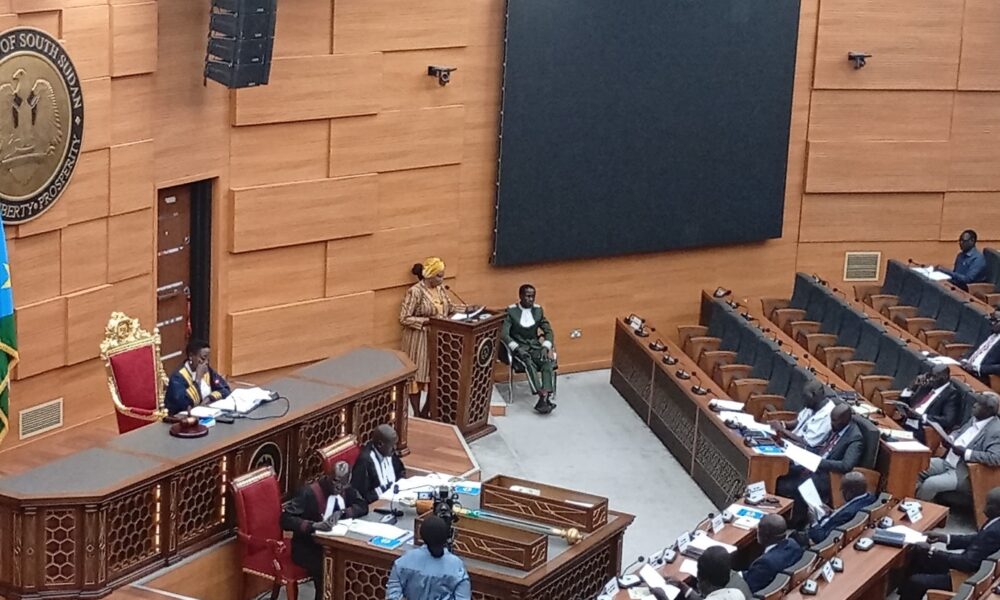
The report was adopted during the 23rd ordinary sitting of the TNLA on Tuesday, in a session presided over by Speaker Jemma Nunu Kumba, marking a key parliamentary endorsement of international commitments on humanitarian action, international humanitarian law, and multilateral cooperation.
The report was presented to the House by Gabriel Guot Guot, a member of the delegation and a parliamentarian serving on the IPU Committee on Democracy and Human Rights.
In his presentation, Guot outlined South Sudan’s participation in the global parliamentary forum, which brought together delegations from 132 national parliaments and 11 regional parliamentary bodies.
According to the report, the central theme of the 151st IPU Assembly focused on “Upholding humanitarian norms and supporting humanitarian action in times of crisis”, a subject Guot said resonated strongly with South Sudan’s own national and regional realities.
“The discussions at the Assembly reflected challenges that South Sudan continues to face, including conflict-related displacement, humanitarian access, food insecurity, and climate-related shocks,” Guot told lawmakers while presenting the report.
According to Guot, the delegation participated in plenary sessions, standing committees, and statutory bodies of the IPU.
The report noted that South Sudan actively contributed to debates that later informed the Geneva Declaration on Upholding Humanitarian Norms, which was adopted by the IPU Assembly.
In remarks referenced in the report, Speaker Kumba underscored South Sudan’s continued commitment to international humanitarian law, despite the country’s protracted challenges.
She highlighted South Sudan’s role as a host to more than 650,000 refugees from neighboring countries, noting that humanitarian principles remain central to national policy.
The TNLA’s adoption of the report effectively commits the legislature to the implementation of key IPU outcomes, including resolutions on humanitarian protection, combating transnational organized crime, cybercrime, and hybrid threats to democracy and human security.
From a regional perspective, the move positions South Sudan’s parliament within a broader East and Central African effort to reinforce humanitarian norms amid ongoing conflicts in Sudan, the Democratic Republic of Congo, and parts of the Horn of Africa.
The report also detailed South Sudan’s engagement in committee-level negotiations, noting that the country submitted amendments to draft resolutions, two of which were adopted unanimously.
This, the delegation argued, demonstrated South Sudan’s growing parliamentary engagement at the multilateral level.
By adopting the report, the TNLA affirmed its role in parliamentary diplomacy and legislative accountability, as IPU member parliaments are required to follow up on adopted resolutions through national action and reporting mechanisms.
Speaker Kumba, in presiding over the session, emphasized the importance of aligning national legislative priorities with international obligations, particularly in areas affecting humanitarian action and civilian protection.
The adoption comes at a time when South Sudan continues to rely heavily on humanitarian assistance, even as regional instability places additional pressure on limited resources.
Parliamentary endorsement of humanitarian norms is expected to bolster the country’s engagement with development partners and regional bodies.
The report concluded with recommendations calling for full implementation of IPU outcomes, signaling expectations that parliamentary committees and relevant institutions will translate international commitments into domestic legislative and oversight actions.