

By Alan Clement
Different stakeholders expressed different views as some parties to the peace agreement reached a resolution to amend the peace agreement in order to allow election as scheduled.
Civil society and human rights activists have warned that proposed amendments to South Sudan’s 2018 peace agreement could strip the transitional government of its legal mandate, triggering a fresh political and constitutional crisis.
At the center of the controversy are Articles 8.2 and 8.3 of the Revitalized Agreement on the Resolution of the Conflict in South Sudan (R-ARCSS), which govern decision-making and consensus among the agreement’s signatories.
They argued that efforts to “delict” or remove these provisions without the full and inclusive participation of all signatories to the agreement amount to dismantling the very framework that ended years of armed conflict and established the current transitional dispensation.
Edmund Yakani, Executive Director of the Community Empowerment for Progress Organization (CEPO) and a stakeholder signatory to the R-ARCSS, described the proposed amendments as a direct threat to the peace deal’s survival.
“The delict of Article 8.2 and 8.3 has nothing to do with election preparation,” Yakani said.
“It is aimed at killing or bringing the R-ARCSS to an end. Once these amendments are endorsed, the R-ARCSS will no longer be legitimate or binding,” he added.
Yakani warned that removing the two articles would effectively strip the government of the authority to implement the agreement’s outstanding obligations, including security sector reform, constitution-making, economic and public finance management reforms, transitional justice, and the repatriation and reintegration of internally displaced persons and refugees.
South Sudan signed the revitalized peace agreement in September 2018 in Addis Ababa after nearly five years of civil war that killed hundreds of thousands of people and displaced millions.
The deal created a power-sharing transitional government and outlined a roadmap toward permanent peace, democratic elections, and a new constitution.
Despite repeated extensions of the transitional period, many key provisions remain unimplemented.
Yakani stressed that attempts to amend Articles 8.2 and 8.3 also threaten hard-won gains achieved under the agreement, including the 35 percent affirmative action quota for women’s participation in government, institutional and policy reforms, and the transitional justice architecture designed to address atrocities committed during the conflict.
“To delict these articles mean violating all the gains of the R-ARCSS,” he said adding, “This is why civil society must reject this attempt, whether it is framed within amendments to the peace agreement or changes to related laws such as the National Elections Act.”
Speaking to this outlet, Human rights activist Ter Manyang Gatwech echoed these concerns, describing Articles 8.2 and 8.3 as the backbone of the peace agreement’s legitimacy.
“These two articles are extremely important within the peace agreement,” Ter told this outlet.
“Any attempt to amend them without the inclusive participation of all signatories, including Dr. Riek Machar and others, undermines both the spirit and the letter of the agreement,” he added.
Ter argued that redefining the constitution-making process undertaken between 2020 and 2022, alongside proposals to rely on outdated population census data, contradicts Article 6.9 of the agreement, which enshrines the principle of permanent constitution as the basis for sustainable peace.
“Overall, these actions suggest that our leaders are not genuinely committed to restoring peace,” he said.
“Instead, they appear to be advancing their own interests,” Ter added.
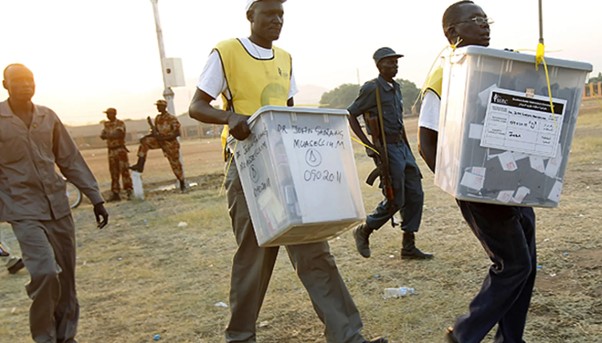
The debate over amendments has intensified as South Sudan inches toward proposed general elections scheduled for December 2026.
The National Elections Commission already announced plans to use the 2010 electoral constituencies and census data, citing logistical and institutional constraints.
Activists said this approach raises serious legal and political questions, particularly in light of constitutional amendments that created three administrative areas in Ruweng, Greater Pibor, and Abyei that did not exist during the 2010 elections.
“Using the 2010 census and constituencies will create contradictions, especially around boundaries,” Ter warned.
Ter added that, “These unresolved boundary issues have already contributed to communal violence, particularly over land.”
He also emphasized that many South Sudanese who were minors during the last census are now of voting age, yet their demographic realities are not reflected in the figures being used to plan elections.
While some political actors argued that a permanent constitution could address these inconsistencies, critics remain skeptical about the feasibility of resolving such complex issues within the current timeframe.
“There is a real risk of chaos and crisis if elections are imposed under the present conditions,” Ter said, recalling the disputed 2010 elections that were followed by unrest in parts of the country.
“If election outcomes are not accepted, then the question of legitimacy will arise again,” Ter cautioned.
Against this backdrop, the Sudan People’s Liberation Movement (SPLM) has defended the proposed amendments and its push toward elections.
On 27 December 2025, the SPLM Secretary General, Dr. Akol Paul Kordit, held a consultative meeting with R-ARCSS stakeholders to brief them on recent political developments and agreed amendments aimed at paving the way for the 2026 polls.
The meeting brought together representatives of youth, women, academia, the business community, civil society organizations, and eminent persons.
Discussions focused on what the SPLM described as adjustments intended to establish a “clear and realistic pathway” toward credible and inclusive elections.
Speaking at the meeting, Dr. Akol reaffirmed the party’s commitment to the full implementation of the R-ARCSS and to working with national institutions, including the National Elections Commission, to deliver elections on schedule.
He also emphasized that there would be no further extension of the transitional period, a position echoed by some stakeholders who stressed the need to return the country to constitutional order through elections.
However, civil society actors maintain that elections cannot substitute for peace and consensus.
They argue that excluding key signatories from decisions on amending the peace agreement risks reopening political fault lines that the R-ARCSS was designed to close.
“Peace cannot be imposed, and elections cannot be imposed,” Ter said stressing that, “If key political actors do not recognize the process or the outcome, then the country will face another legitimacy crisis.”
As South Sudan approaches the seventh anniversary of the revitalized peace deal, the dispute over Articles 8.2 and 8.3 underscores a deeper tension between deadline-driven politics and the unresolved foundations of peace.
For many civil society leaders, the warning is stark: weakening the legal core of the R-ARCSS may not accelerate the transition but may instead unravel it.