

By Yiep Joseph
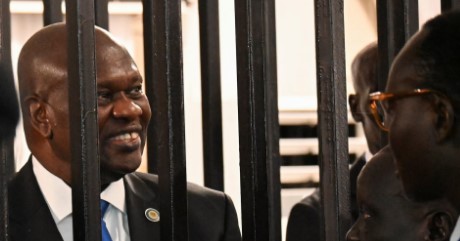
After several open court hearings, the special court trying Puot Kang and the seven co-accused, including suspended First Vice President Dr. Riek Machar Teny, is set to hold sessions in-camera.
An in-camera refers to a legal proceeding conducted in private, away from public view, to protect sensitive information and the privacy of the parties involved.
It is employed in specific circumstances where public access could compromise the integrity of the proceedings or the safety of individuals involved.
The decision by the court to start the session in-camera was a response of the presiding judges to the request of the prosecution team, who earlier requested the protection of some of the witnesses.
In November, the prosecution team announced that 16 witnesses were ready to testify before the court, among whom 8 will testify in open court while the rest need protection.
The defense team, however, objected to the request.
However, after six witnesses testified in an open court, the prosecution team requested the court to respond to their request for the protection of the remaining witnesses.
In line with the protection of witnesses, the 37th session, which was scheduled for the court to respond and make a ruling on the demand for protection of witnesses, came with a fresh pronouncement.
The court during Monday’s session temporarily barred the public and media from attending the sessions where the witnesses that need protection will start to testify.
The court decision followed a request by prosecutors, who said some witnesses had faced threats and intimidation linked to the case.
The three-judge panel ruled that only judges, prosecutors, defense lawyers, interpreters, and the accused would be allowed in the courtroom during closed sessions. Judges also ordered that the identities and contact details of witnesses not be disclosed.
Stephen Simon, a member of the panel, said the court had determined that holding certain sessions in camera was necessary to safeguard witnesses.
He warned that publishing any information that could reveal witness identities or endanger them or their families would constitute a criminal offense.
While acknowledging the seriousness of witness intimidation, the court emphasized that criminal trials should generally be conducted in open court.
Judges ruled that protective measures must be necessary, proportionate, and applied on a case-by-case basis rather than through a blanket closure.
Machar and his co-accused face charges including murder, conspiracy, terrorism, treason, destruction of public property, and crimes against humanity.
Prosecutors allege that forces allied to the SPLA-IO and the White Army killed 257 SSPDF soldiers, including Gen. David Majur Dak, and destroyed or seized military equipment valued at approximately $58 million during the March 2025 attack on the Nasir garrison.