


By Alan Clement
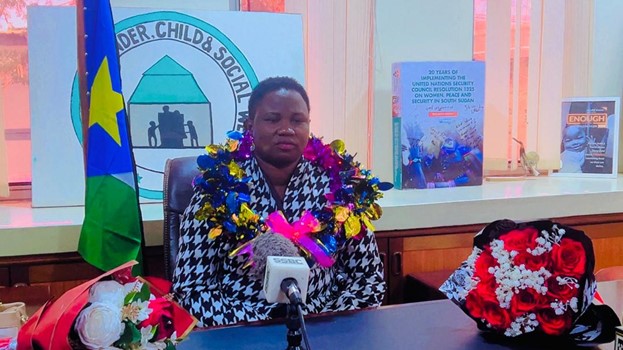
South Sudan’s Ministry of Gender, Child and Social Welfare will prioritize women, children and persons with special needs, newly appointed minister Nuna Rhoda Rudolf Ndefu said, citing conflict, poverty and limited state capacity.
Speaking in Juba during her first public address after assuming office, Nuna Rhoda framed the ministry’s mandate around protecting and supporting what she described as the country’s most vulnerable populations amid persistent political, economic and humanitarian pressures.
“The ministry serves the core group of the future generation namely women, men, children and people with special needs,” Ndefu said.
She stressed that women and children, in particular, continue to bear the heaviest burden of hardship arising from conflict, economic distress and natural shocks.
South Sudan remains one of the world’s most fragile states, grappling with the legacy of years of armed conflict, weak service delivery and repeated climate-related disasters, including floods that have displaced hundreds of thousands of people.
Women and children account for the majority of those affected by displacement, food insecurity and protection risks, while persons with disabilities face chronic exclusion from social services and livelihoods.
Against this backdrop, Rhoda acknowledged that the scale and complexity of needs facing vulnerable groups exceed the capacity of government institutions acting alone.
“Their needs and challenges are numerous, delicate and more complex to be handled by the government alone,” she said, underscoring the importance of partnerships.
“Hence, I count on the cooperation and support of our partners both national and international,” the minister added, signaling continuity with a long-standing reliance on humanitarian agencies, United Nations bodies and civil society organizations in delivering gender, child protection and social welfare services.
Rhoda also emphasized internal coordination as a priority, describing teamwork and mutual cooperation as the guiding approach of her tenure.
She said this would extend beyond international partners to include sister ministries, state governments and ministry staff.
“Team work and mutual cooperation is going to be our slogan,” she said, noting that effective service delivery requires alignment across government levels.
In remarks reflecting her political backing, Rhoda expressed gratitude to President Salva Kiir Mayardit for appointing her to the position, saying the decision placed significant trust and responsibility on her leadership.
She also acknowledged the role of her party, the SPLM-IO, thanking its interim leadership under Ambassador Stephen Par Kuol for endorsing her appointment.
“I would like to assure the president and our party leadership that I would do all within my ability to meet their expectation and confirm the trust you have in me,” Rhoda said, adding that she was fully aware of the weight of the ministry’s mandate.
She further paid tribute to the outgoing minister, Aya Warille, and her team, crediting them for the work accomplished during their tenure.
The transition comes at a time when the ministry faces mounting expectations to address gender-based violence, child protection concerns, social assistance gaps and the inclusion of persons with disabilities within national development frameworks.
Closing her remarks, Rhoda signaled a participatory leadership style, committing to consult widely while emphasizing collective responsibility for results. “I will listen and talk but the action, we shall do them together,” she said.
Her statements set the tone for a ministry expected to navigate constrained resources, high humanitarian needs and complex coordination demands, while remaining central to South Sudan’s efforts to protect its most vulnerable citizens.