



By Alan Clement
South Sudan is increasingly serving as a humanitarian transit corridor for thousands fleeing the conflict in Sudan’s Kordofan regions. These arrivals often cross the border only to move onward, exposing significant gaps in protection, monitoring, and regional displacement planning.
Between December 5 and January 20, an estimated 6,522 people crossed from West and South Kordofan into South Sudan, according to a UNHCR flash update covering movements through Unity State and the Ruweng Administrative Area.
While many are refugees and returnees seeking permanent safety, humanitarian agencies report that a significant number are using South Sudan as a short-term passage before re-entering Sudan at different points. UNHCR observed roughly 2,000 individuals crossing via the Panakuach border point in early December before continuing onward to re-enter Sudan through the Liri border point in South Kordofan.
Border monitors noted that while these “fluid” movements are ongoing, they remain difficult to quantify. “These movements reflect a short-term evacuation dynamic,” noting that those transiting quickly often have “limited engagement with reception or protection services.” UNHCR stated
The latest influx is part of a massive displacement crisis triggered by the war in Sudan, which erupted in April 2023. Since then, South Sudan has received approximately 1.3 million new arrivals. While most enter through Upper Nile State’s Renk and Joda points, the routes through northern Unity State and Ruweng specifically Panakuach now rank as the second-highest entry corridors.
Humanitarian agencies attribute the renewed arrivals to intensified fighting, deteriorating security, the forced recruitment of youth, and severe shortages of food, healthcare, and education. Recent weeks have seen a notable surge from South Kordofan localities, including Kadugli and Talodi.
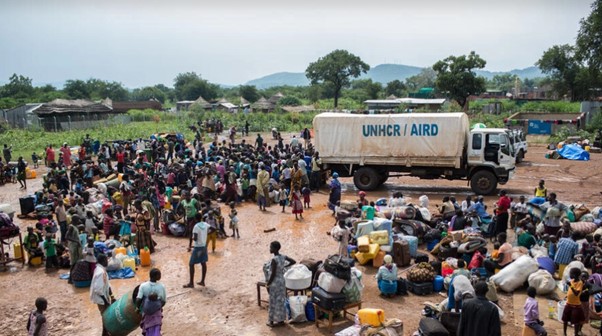
The logistics of the arrival vary by status, primarily crossing through the Jau and Liri entry points, Most enter via Panakuach and are transported to UNHCR-supported facilities before relocation to the Ajuong Thok and Pamir refugee camps.
Thousands remain temporarily stalled within South Sudan. Of the nearly 4,000 people who arrived through Panakuach during the reporting period, most moved to a transit site in Rotriak Lalop. The site described as an open area lacking permanent shelter was hosting 402 individuals at the time of reporting and requires immediate humanitarian aid.
Meanwhile, 2,605 people arriving through Jau and Liri have sought help at reception centers. The Yida Reception Centre is currently hosting 656 individuals more than double its intended capacity. To ease this congestion, UNHCR relocated over 2,600 refugees to the Ajuong Thok and Pamir camps as of mid-January.
New arrivals report widespread violence along the route, including looting, armed robbery, and intimidation. Many families were forced to abandon main roads to avoid conflict hotspots, prolonging their journeys and increasing psychological distress.
High transportation costs have further compounded these vulnerabilities. While some managed to pay for transport from towns like Kadugli, others were forced to walk long distances, arriving physically exhausted and in urgent need of medical attention.
In response, UNHCR and local authorities have scaled up border monitoring and registration. The World Food Programme (WFP) is providing hot meals and incorporating arrivals into general food distributions.
However, UNHCR warned that reduced funding and staffing shortages are limiting the ability to surge operations, particularly for onward transportation. Consequently, the agency has lowered its “contingency trigger” for emergency response from 350 to 150 arrivals per day.
While arrivals from West Kordofan have slowed, movements from South Kordofan remain unpredictable. UNHCR estimates that reception facilities in Yida and Pamir can host up to 800 people, but warned that without donor support, the capacity to monitor borders and ensure adequate staffing will remain severely constrained.
As Sudan’s conflict continues to fragment civilian movement, South Sudan’s role as a temporary corridor underscores the urgent need for stronger regional coordination and sustained funding to protect those in flight.