



By Chol D. Johnson
The government is set to implement economic stabilization and structural reforms passed last week by the cabinet.
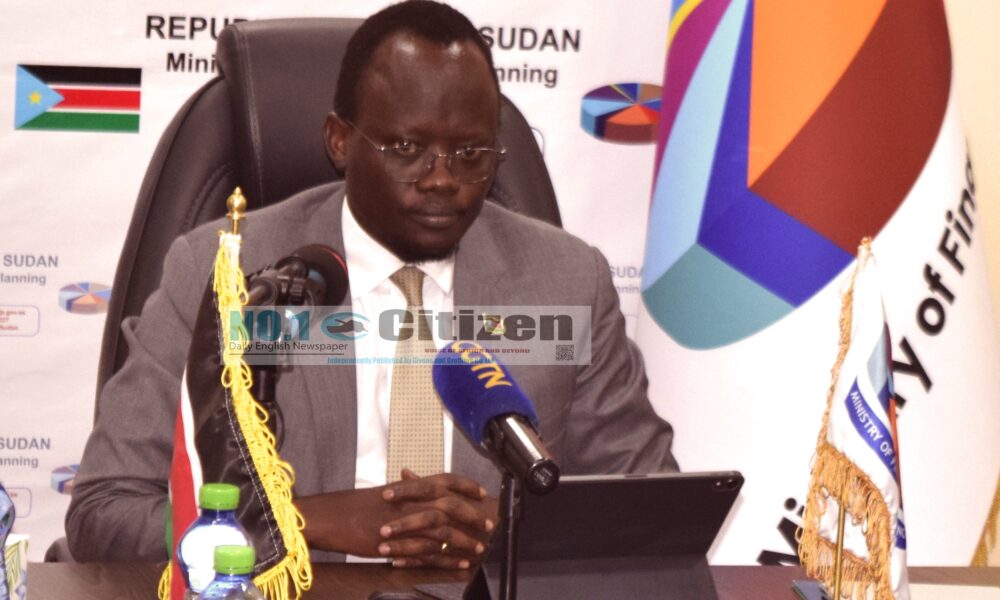
Speaking during the press conference on Wednesday, Minister of Finance and Planning Bak Barnaba Chol announced that the reforms will now move into the implementation phase.
“After the announcement, an implementation matrix will be shared. This internal matrix will include ministerial orders and policies for the execution of this important policy,” Barnaba stated.
He emphasized that following the cabinet resolution, the council of ministers has officially adopted economic stabilization and structural reforms as government policy.
Barnaba explained that the framework will guide collective responses to prevailing economic challenges and reposition the economy toward stability and sustainable growth.
“The resolution of the cabinet is a framework to guide our collective response to the prevailing economic challenges and to reposition our economy toward stability and sustainable growth,” he said.
The minister highlighted that the cabinet-owned policy reflects collective deliberations within the economic cluster, with inputs from key institutions including the Bank of South Sudan, the South Sudan Revenue Authority, sector ministries, and other relevant authorities.
“This policy, which I presented to the council of ministers, was carefully assessed,” Barnaba noted.
He underscored that the current economic situation—acknowledged by the presidency—requires tough procedures and policies.
“Our people are undergoing suffering, and the resilience they have shown requires key decision-making,” Barnaba expressed.
He identified inflationary tendencies, currency instability, and structural imbalances largely driven by over-reliance on oil revenues and limited domestic production or non-oil revenue collections as major challenges.
The cabinet, he said, has directed the government to move beyond fragmented interventions and adopt a coherent stabilization and reform framework grounded in realism, phased implementation, and strong institutional coordination.
“At the core of this policy is the enhancement of fiscal discipline and budget credibility,” he reiterated.
Barnaba explained that the cabinet has approved targeted fiscal adjustments aimed at protecting social and political stability while restoring confidence in public finances.
“Government will enforce absolute prioritization of salary payments, essential government operations including security, peace implementation, and elections,” he said.
He acknowledged that payments for non-essential claims, contracts, and expenditures will be limited, while recruitment across government institutions will be temporarily halted except for clearly justified critical needs.
“This will be done in collaboration with the Ministry of Public Service and other relevant institutions,” he added.
Barnaba outlined revenue enhancement measures, including oil sector reform, the introduction of value-added tax, expansion of non-oil revenues, review of EPSA and SOFA agreements, and cancellation of non-statutory tax exemptions.
“Together with the Bank of South Sudan, we shall work on alignment between fiscal and monetary policy to address liquidity-related issues, treasury single account, foreign exchange market management, and financial sector reforms,” he noted.
He further stated that the Ministry of Foreign Affairs and International Cooperation will be engaged to enhance the welfare of diplomatic missions.
Barnaba said the economic cluster will focus on building the private sector, supporting SMEs, and strengthening public-private partnerships.
“We shall also focus on agriculture, livestock, fisheries, tourism, wildlife, agro-processing, as well as mining and extractive industries in coordination with the Ministry of Mining and other institutions,” he mentioned.
Trade facilitation, export promotion, and value-addition initiatives will also be advanced in collaboration with the Ministry of Trade and Industry, with emphasis on high-potential commodities such as sesame, gum arabic, and other export-oriented products.
He stressed that policy implementation will be anchored in strong government coordination mechanisms, inter-ministerial arrangements, and the economic cluster.
Barnaba added that the Economic Stabilization and Structural Reform Policy is a council-endorsed framework representing a deliberate program of adjustment, enhancement, and rationalization designed to stabilize the economy.
He stated that the policy aims to protect livelihoods and lay the foundation for sustainable and inclusive growth.
“I would like to tell the members of the press and the public that government is committed not only to policy articulation but to disciplined implementation, transparency, and accountability,” Barnaba concluded.