




By Alan Clement
The African Union has renewed calls for an immediate ceasefire in Sudan, warning of deepening regional repercussions, while commending South Sudan for hosting thousands of Sudanese refugees despite its own fragile post-conflict recovery.
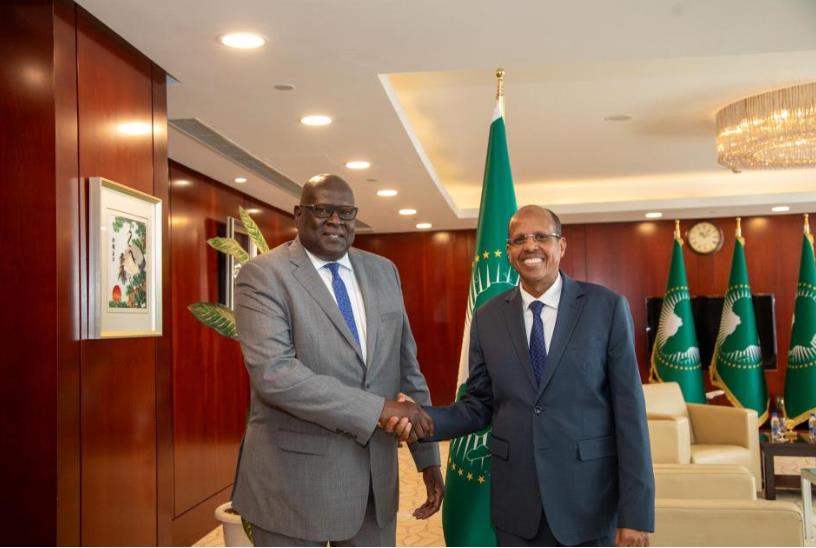
The appeal was made during a meeting in Addis Ababa between the Chairperson of the African Union Commission, Mahmoud Ali Youssouf, and South Sudan’s Deputy Minister of Foreign Affairs and International Cooperation, Akuei Bona Malwal.
According to the AU Commission, discussions centred on the deteriorating conflict in Sudan and its growing impact on neighbouring countries, particularly South Sudan, which has received large numbers of civilians fleeing violence since fighting erupted between rival military factions in April 2023.
“The Chairperson stressed the urgent need for a ceasefire, a cessation of hostilities, and a return to constitutional order in Sudan,” the AU said in a statement, underscoring that the protracted conflict continues to destabilise the wider Horn of Africa region.
Sudan’s war has displaced millions internally and forced hundreds of thousands to cross borders into South Sudan, Chad, Egypt, Ethiopia, and the Central African Republic. In South Sudan alone, refugees and returnees have placed additional strain on already limited services, including food supply systems, healthcare, shelter, and education.
Despite these challenges, Youssouf commended Juba’s continued solidarity with Sudanese civilians. He praised South Sudan for keeping its borders open and providing refuge “in the spirit of African solidarity,” even as the country navigates its own humanitarian and economic pressures.
South Sudan is itself home to significant numbers of internally displaced people and returnees following years of conflict and flooding, compounding the burden on host communities in border areas such as Upper Nile, Unity, and Northern Bahr el Ghazal states.
The Chairperson reaffirmed the African Union’s position that the crisis in Sudan cannot be resolved through military means and requires an inclusive, African-led political process.
He reiterated the AU’s commitment to supporting dialogue initiatives aimed at ending the violence and restoring civilian-led constitutional governance in Khartoum.
The meeting also reviewed the broader regional security environment, including the unresolved Abyei issue between Sudan and South Sudan. Both sides emphasised the need for a durable and mutually acceptable solution to the disputed area, noting that instability in Abyei remains a potential flashpoint amid heightened regional tensions.
While the focus of the engagement was Sudan, Youssouf also linked regional stability to progress in South Sudan’s own peace process.
He underscored the importance of implementing the Revitalised Agreement on the Resolution of the Conflict in South Sudan (R-ARCSS), noting that peace consolidation in Juba would strengthen the country’s capacity to respond to regional crises.
For his part, Deputy Minister Akuei Bona Malwal expressed appreciation for the AU Chairperson’s leadership and sustained engagement on peace and security matters affecting the region.
“He thanked the Chairperson for his support toward peace and stability in South Sudan and the wider region,” the AU said, reaffirming Juba’s commitment to regional cooperation and African-led solutions.
South Sudan has repeatedly called for an end to the fighting in Sudan, warning that continued hostilities risk reversing fragile gains across the region. The conflict has disrupted cross-border trade, driven up food prices, and heightened security concerns along shared borders.
The African Union has maintained diplomatic efforts through mediation initiatives and coordination with regional blocs, insisting that the protection of civilians and humanitarian access remain central to any settlement.
As the war in Sudan enters another year with no comprehensive ceasefire in place, the AU’s renewed call highlights growing concern over the conflict’s spillover effects and the limits of neighbouring states’ capacity to absorb its humanitarian consequences without sustained international and regional support.