


By Alan Clement
The African Union has intensified calls for sweeping financing reforms and stricter expenditure control, as fragile economies such as South Sudan struggle under mounting fiscal pressure that threatens to undermine Africa’s broader integration ambitions.
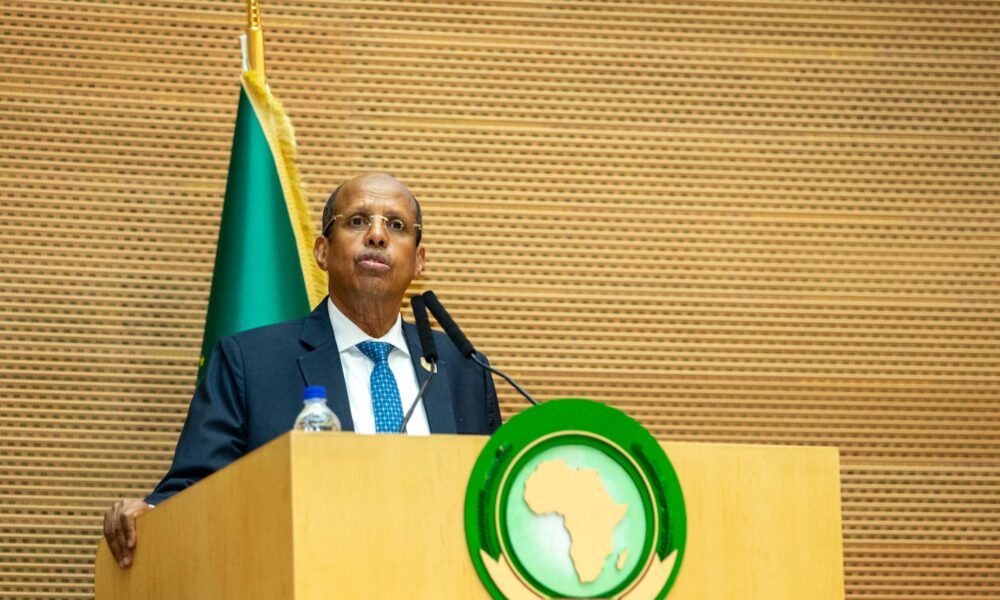
Addressing the 48th Ordinary Session of the Executive Council, AU Commission Chairperson Mahmoud Ali Youssouf said the Commission is pursuing reforms aimed at aligning spending with strategic objectives while improving financial sustainability across the institution.
“The African Union Commission is pursuing its efforts for reform. It has focused on controlling expenditure and aligning resources with established objectives,” Youssouf told foreign ministers gathered in Addis Ababa.
He confirmed that the Commission’s 2024–2028 Five-Year Plan has been approved and that implementation of institutional restructuring under the SACA reform framework is underway.
The reform process is being steered under the leadership of William Ruto, who is overseeing key components including financing, division of labour, peace and security architecture, and the African Court of Justice.
“We must admit that these are difficult issues that will certainly be the subject of in-depth deliberations by our Leaders,” Youssouf said, underscoring the political sensitivity of funding reforms.
The renewed push for financial discipline at continental level comes as South Sudan faces one of the most severe fiscal crises since independence. Public debt has surged, oil production remains vulnerable to external disruptions, and social spending on health, education and social protection has sharply contracted.
Although the AU speech did not single out individual member states, the financing debate has direct implications for countries like South Sudan, whose domestic revenue base remains narrow and heavily dependent on oil exports.
Any disruption in oil flows whether due to conflict in neighbouring Sudan or technical challenges reverberates immediately through the national budget.
Youssouf stressed that development and integration remain central pillars of the Union’s agenda, pointing to the operationalisation of the African Continental Free Trade Area (AfCFTA) and the work of specialised agencies.
“The AfCFTA and the Specialised Agencies are in the forefront of our multilateral actions. Progress is tangible and the Guided Trade Initiative serves as a reminder,” he said.
For South Sudan, however, participation in continental trade integration remains constrained by structural weaknesses; limited infrastructure, underdeveloped manufacturing capacity, and persistent macroeconomic instability.
While the AfCFTA framework promises expanded market access, countries with fragile fiscal systems risk marginalisation if they cannot meet regulatory, customs and infrastructure benchmarks.
The AU Chairperson also called for innovative funding mechanisms and greater involvement of the African private sector, civil society and philanthropic foundations in financing development programmes.
“We must ponder over innovative funding sources, involve the African Private Sector in our programmes, Civil society, Philanthropic Foundations; no actor, however marginal, should be overlooked,” Youssouf said adding that “Money is the lifeblood of Development and Prosperity.”
His remarks reflect growing concern within the Union about overreliance on external partners. A significant portion of AU programmes particularly in peacekeeping, humanitarian response and public health remains donor-funded. Financial unpredictability at global level has added urgency to internal reform efforts.
For South Sudan, declining international aid flows compound domestic fiscal distress. The government is already struggling to meet salary obligations and finance basic services, while humanitarian needs remain acute in several states affected by flooding, displacement and food insecurity.
The AU’s emphasis on expenditure control also intersects with longstanding governance concerns. Between 2017 and 2023, South Sudan’s government spending averaged a high proportion of GDP compared to peer countries, yet only a limited share reached social sectors.
At the Executive Council session, Youssouf stressed the need to streamline summit agendas and focus on strategic priorities, acknowledging concerns about efficiency within AU structures.
“The key to the success of our meetings lies in our ability to focus on strategic issues and questions of absolute priority,” he said.
As African leaders prepare for the upcoming Summit, the financing debate is likely to take centre stage.
For South Sudan and similarly fragile economies, the outcome may prove decisive: without stronger fiscal foundations and credible reform at national level, participation in Africa’s integration project risks becoming aspirational rather than transformative.
The AU’s message is clear; continental reform is advancing. Whether fragile member states can keep pace will determine how inclusive Africa’s next phase of economic integration becomes.