


By Alan Clement
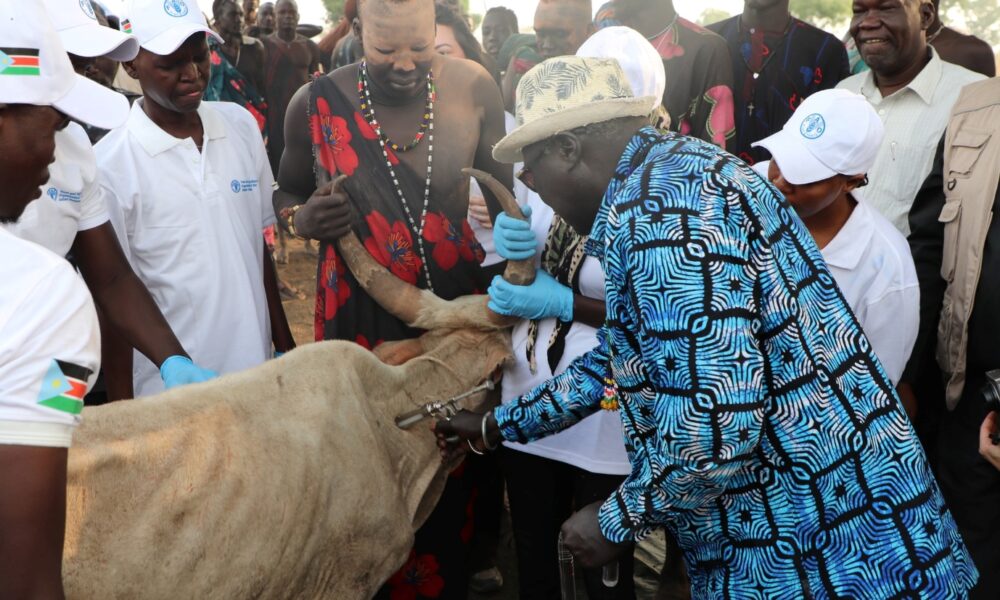
South Sudan has formally advanced a One Health strategy aimed at preventing zoonotic disease spillover, as national authorities and United Nations agencies launched a coordinated dry-season livestock vaccination campaign in Dijere cattle camp.
The initiative brought together the Ministry of Livestock and Fisheries, the World Health Organization (WHO) and the Food and Agriculture Organization of the United Nations (FAO) under a framework that integrates animal, human and environmental health interventions in high-risk settings.
Speaking at the launch, WHO Representative in South Sudan Dr. Humphrey Karamagi said the country’s cattle camps represent a critical convergence of livelihoods, ecology and public health, making them strategic entry points for outbreak prevention.
He emphasized that the One Health approach is not merely a veterinary campaign but a public health safeguard designed to interrupt disease transmission at its source. The dry-season vaccination drive targets nine priority diseases affecting cattle, small ruminants, poultry and companion animals.
For cattle, authorities are vaccinating against anthrax, contagious bovine pleuropneumonia, haemorrhagic septicaemia and black quarter. Small ruminants are being immunized against peste des petits ruminants, contagious caprine pleuropneumonia and sheep and goat pox.
Newcastle disease vaccines are being administered to poultry, while rabies vaccination is being rolled out for pets and companion animals.
Officials said the timing is critical as during the dry season, herds converge around shrinking water sources, increasing animal-to-animal contact and heightening the risk of infectious disease spread.
In such environments, zoonotic pathogens; those transmissible from animals to humans can move rapidly across species, particularly in densely populated cattle camps where families live in close proximity to livestock.
Officials noted that integrated campaign strengthens national disease control systems by aligning veterinary services with public health surveillance. Livestock health underpins rural food security, income generation and social stability, making disease prevention a national priority.
Beyond vaccination, the campaign incorporates strengthened early warning mechanisms, joint surveillance, and the deployment of integrated mobile human and animal health teams.
The approach also links public health to peacebuilding and resilience efforts, including water, sanitation and hygiene interventions designed to reduce vulnerability in cattle camp communities.
WHO officials underscored that protecting animal health directly protects human health, particularly in a country where milk remains a primary source of childhood nutrition and livestock are central to household economies.
They warned that without sustained preventive action, cattle camps can act as amplifiers for outbreaks, with potential cross-border implications.
The launch signals a broader policy shift toward institutionalizing One Health coordination in South Sudan’s disease preparedness architecture, as authorities confront recurrent climate shocks, population displacement and fragile health systems.
Partners described the campaign as a model for multisectoral collaboration, aimed at reducing preventable livestock deaths, safeguarding livelihoods and strengthening national capacity to detect and respond to emerging health threats before they escalate into major outbreaks.