


By Kei Emmanuel Duku
A high-stakes legislative battle is brewing in South Sudan as a new proposed revenue law seeking to tax livestock transit faces a formidable obstacle: a political elite who own the very herds the law intends to regulate.
During the hearing for the 2025/2026 National Budget in February 2026, South Sudan’s Minister of Livestock and Fisheries, Onyoti Adigo Nyikwec, made a definitive case for the introduction of taxes on the country’s livestock to bolster domestic revenue. His statements focused on transforming the livestock sector from a traditional cultural practice into a commercial economic pillar.
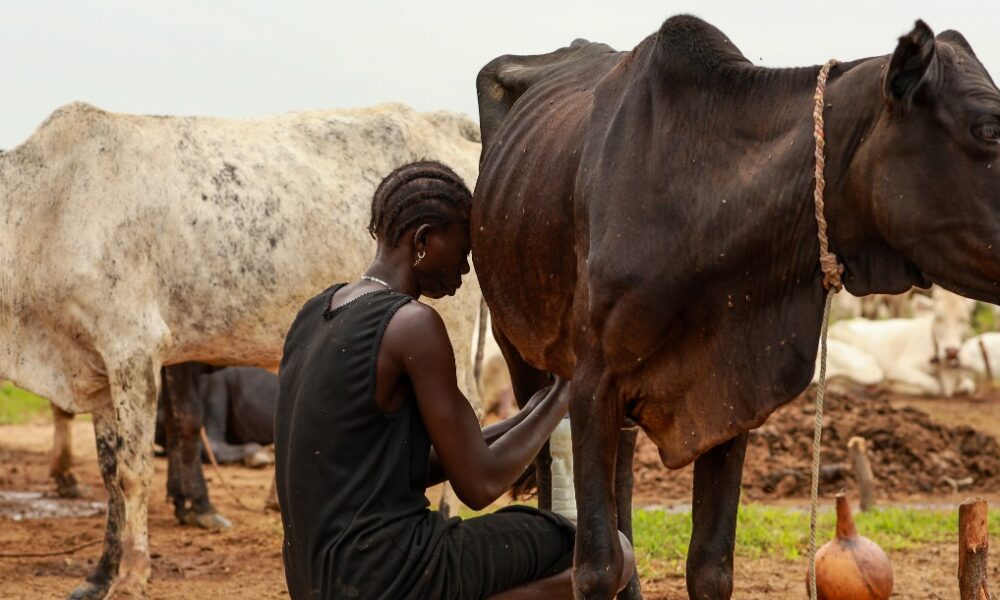
Minister Onyoti emphasized that while South Sudan is home to an estimated 36 million head of cattle, the national treasury sees almost no benefit from this massive resource. He argued that if properly regulated and taxed, this population could become a primary source of government income, finally reducing the nation’s heavy reliance on oil.
However, Boboya James Edmond, a prominent South Sudanese policy analyst and the Chief Executive Officer of the Institute of Social Policy and Research (ISPR), warns that while the policy could curb communal violence and generate wealth, its success hinges entirely on the political will of a leadership class heavily invested in the cattle industry.
“There’s going to be a huge challenge because the people in leadership, including the President himself, have cattle and some of these cattle are also in the Equatorial region and even in some Juba area,” Edmond observed.
The analyst emphasized that without genuine political will, the legislative journey for this proposal—which must undergo rigorous debate in Parliament and be strengthened at state and county levels—will be difficult. “But, if people put the interests of the nation first and the interests of developing the country, I think things will be more possible,” Edmond added.
He cautioned that without a broader consensus, security issues will continue to emanate, leading to persistent community violence that prevents local economies from thriving.
According to the policy analyst, the central component of the proposal is the introduction of taxes on the movement of livestock across internal borders. Currently, while cattle sold in markets attract fees, there are no taxes on the transit of cattle, goats, or sheep. This lack of regulation has facilitated the “masquerading” of cattle across the Equatorial region, worsening security conditions for farmers.
“The taxation needs to be in a way of restricting movements of cattle from one area to the other, so that that also reduces conflict, reduces violence, and also increases productivity,” Edmond explained.
Under the proposed mechanism, taxes would be charged per head of livestock, functioning similarly to taxes on vehicles or goods moving between states. “For example, they will say any cow will be attracting maybe 1,000 pounds when it crosses the border,” Edmond noted.
He argued that cumulative taxes across multiple counties—such as Terekeka, Juba, Lanya, and Yei—would create a financial deterrent for those moving large herds. “By the time you pay more taxes, actually you’re losing the cost of a cow… so then, you’ll be restricted from even going to many other areas.”
The analyst further alleged that much of the current cattle movement is driven not by a search for grazing land, but by political and ideological motives. He suggested that some herds are intentionally moved to cause problems in specific communities, fueled by tribal attitudes.
“To punish some of those political elite with their ideological and political attitudes, have the taxes policies that could really restrain that process of inciting conflict through farmers-pastoralist policy,” Edmond said, while acknowledging that the political class may resist such a move.
The consequences of unregulated movement are already being felt. In Yei, several people were killed recently and over 200 cows were stolen. This violence has left farmers in the current agricultural season terrified to cultivate. The proposed taxes are intended to restore confidence among farming communities and ensure food security in the coming year.
South Sudan is home to more than 30 million livestock—a figure that nearly triples its human population of 12 million. Edmond argued that the country must transition from viewing livestock as a source of individual pride to a source of wealth creation and economic resilience.
He called for a comprehensive livestock policy that defines the economic value of cattle and prioritizes value addition. “The priority should be in terms of adding value addition to the livestock that we’re having,” Edmond concluded, stressing the need for security backing from police and livestock authorities to ensure taxes are paid and that communities understand the necessity of keeping cattle in designated areas.