


By Alan Clement
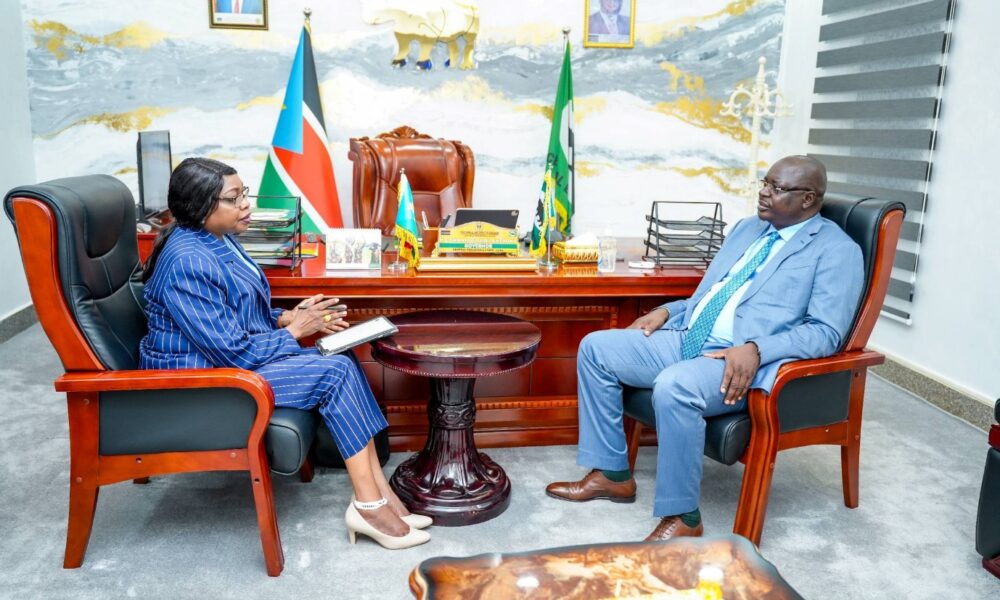
Central Equatoria State is poised for a major overhaul of its healthcare system following a high-level meeting between Governor Emmanuel Adil Anthony and National Minister of Health Sarah Cleto Rial.
During the high-level meeting held on Monday, State Minister of Health Najwa Mursal joined the two leaders as they reaffirmed their commitment to strengthening the health sector and pledged to prioritize the training, equipping, and deployment of medical professionals.
They further committed to enforcing stricter regulation of private health facilities and upgrading key health centers, notably Tali Primary Healthcare Center in Terekeka County underscoring the urgent need to expand access to quality healthcare across communities.
The discussions underscored the urgency of addressing systemic gaps in service delivery across the state. Both leaders emphasized that health remains a cornerstone of citizen welfare and national development, requiring immediate and coordinated action.
During their discussions, Governor Adil highlighted the acute shortage of qualified personnel in state facilities. “Health is life, and therefore we in Central Equatoria State have equally a lot of challenges surrounding health, especially funding,” he said.
He noted that while South Sudanese universities continue to graduate doctors and nurses, many remain unemployed or underutilized due to limited deployment opportunities.
The governor’s concerns were echoed by Health Minister Cleto who pointed out that the country’s human resource potential is not being fully harnessed. “We have so many doctors graduating from local universities in South Sudan, but they are not being deployed in the states or in the Boma,” she said.
She pledged to collaborate closely with the state government to ensure that trained medical professionals are not left idle but strategically deployed to the areas of greatest need, with a particular focus on strengthening services in underserved rural communities.
The leaders further turned their attention to the regulation of private health facilities, with Governor Adil warning that without firm oversight and accountability, citizens remain vulnerable to substandard and inconsistent care.
“We have to support health, and more importantly, regulate the private health facilities so that we have adequate and better services on health in our state and in the country,” he said.
He appealed to stakeholders, including members of parliament, to raise allocations to the health budget, stressing that dwindling donor contributions have left a critical gap in financing.
“Although we are aware that most of the funding from our donor communities has been reduced, we are actively discussing ways to bridge that gap,” he explained, underscoring the urgency of domestic resource mobilization to sustain essential services.
The Governor underscored that regulation, combined with improved infrastructure and professional training, would help restore public confidence in the health system.
Governor Emmanuel Adil underscored infrastructure development by highlighting the Tali Primary Healthcare Center in Terekeka County as a strategic facility serving communities across Central Equatoria, Lakes, and Western Equatoria states, positioning it as a cornerstone for regional health access and resilience.
The Governor appealed for the center to be upgraded to full hospital status, emphasizing the need to expand its capacity to deliver surgical care and other advanced medical services that the community urgently requires.
“We have requested that Tali, because it serves the people from the Lakes state, Central Equatoria and Western Equatoria, be upgraded to a hospital so that surgery and other services can be run,” he said.
Minister Cleto confirmed plans for a joint field visit to Tali PHCC, where a team of technical experts will accompany him to conduct a thorough assessment of the center’s capacity and determine the feasibility of upgrading it to hospital status.
“Our first visit will be to Tali Primary Health Care Centre, which we will undertake together with the Minister of State,” she said.
She explained that the Governor had already outlined the facility’s role and the community it serves, noting that local leaders have requested its elevation to hospital status. “On our visit, I will be accompanied by my technical staff, who will advise on how best to move forward with this request,” she added.
Beyond workforce and infrastructure, the meeting also addressed pressing social health concerns, including drug abuse among youth. Minister Cleto highlighted the need for joint interventions to curb the growing problem, which she said undermines public health and social stability.
She outlined a special initiative focusing on reproductive health and newborn care in hard-to-reach areas, targeting 23 facilities nationwide with two in each state, and both leaders expressed gratitude for the opportunity to collaborate while reaffirming their commitment to improving healthcare delivery.
Central Equatoria is advancing healthcare delivery by addressing workforce gaps, strengthening regulation, and investing in infrastructure to ensure reliable, accessible, and quality services.