

By Chol D. Johnson
South Sudan and Arab Republic of Egypt have reaffirmed commitment in strengthening bilateral coordination and advancing preparations for the upcoming 20th Nile Day Regional Celebration.
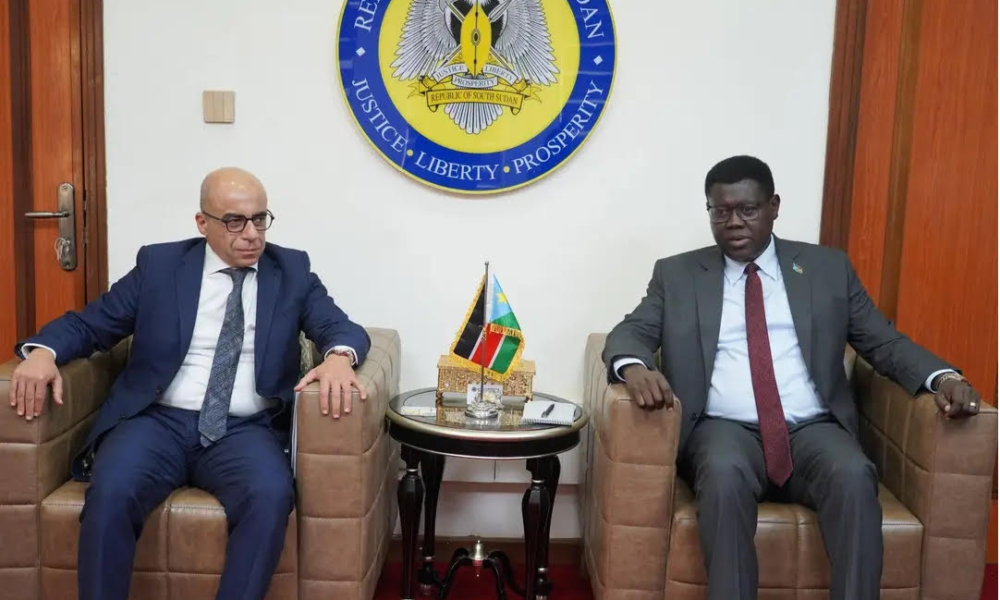
In a statement issued by the Ministry of Foreign Affairs Press Unit on Tuesday, Monday Semaya Kumba, the minister of Foreign Affairs meets with Hazem Mamdouh Fawzy, Ambassador of the Arab Republic of Egypt to South Sudan in his office in Juba.
“Ambassador Monday Semaya K. Kumba, Minister of Foreign Affairs and International Cooperation, held constructive meeting on Tuesday with Hazem Mamdouh Fawzy, Ambassador of the Arab Republic of Egypt to the Republic of South Sudan” the press statement.
According to the statement the meeting focused on strengthening bilateral coordination and advancing preparations for the upcoming 20th Nile Day Regional Celebration.
The Nile Day Regional Celebration will be hosted by the Republic of South Sudan on 22 February 2026.
Both sisterly countries underscored the importance of the event in fostering cooperation among Nile Basin countries.
The event will also reinforce a shared strategic interest among member states during the Celebration.
The discussions further covered cooperation in water resources between the South Sudan sisterly border Egypt.
“The two countries reaffirmed commitment to addressing issues of mutual concern in South Sudan and Egypt” the statement partly read.
They emphasized their shared determination to build upon the outcomes of this engagement.
Furthermore, they also highlighted on elevating the longstanding relations between the two sisterly nations to broader horizons of partnership and strategic cooperation.
Nile Basin is the second largest hydrographic basin in Africa and effectively the most notable drainage basin on the continent.
It covers approximately 2,870,000 km2 or about 10% of African territory crossing arid regions and with a high population density.
The Nile Basin Initiative (NBI) has been in existence since 1999, with the aim of strengthening cooperation in sharing its resources concerned.
The drainage area of the basin covers Burundi, Chad, the Democratic Republic of the Congo, Egypt, Eritrea, Ethiopia, Kenya, Rwanda, South Sudan, the Sudan, Tanzania, and Uganda.
It is also the main supplier of fresh water, electricity, and fish for the local residents of these countries, supporting about 270 million inhabitants, or 20% of the African population.
The basin rises in the highlands and flows in extremely arid regions, in particular the Sahara Desert.
Its main navigable course is through the Nile River, being the mouth section in the Mediterranean Sea (more precisely after the Nile Delta) until it surrounds the city of Aswan, in southern Egypt.