


By Alan Clement
The European Union and the International Organization for Migration (IOM) have launched a new initiative to help displaced communities in South Sudan rebuild safely and with dignity, focusing on climate‑hit Rubkona County and recovery‑driven Yei River County.
According to a statement from EU South Sudan, the programme, titled Catalysing Durable Solutions, is designed to provide long‑term, practical support for people uprooted by conflict and climate shocks, as well as for the communities that host them.
It marks one of the most ambitious joint efforts to date to address displacement in South Sudan’s fragile urban and rural settings.
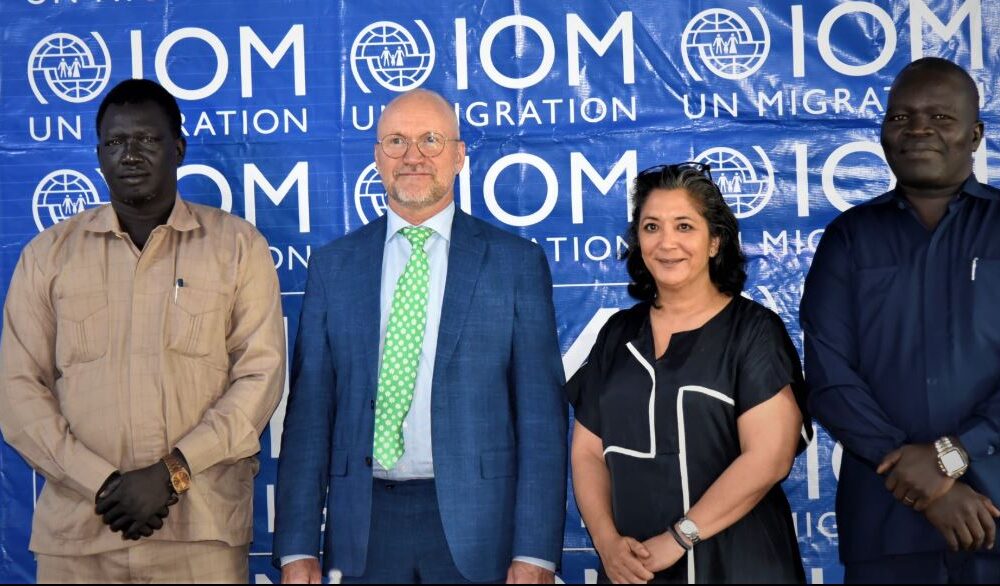
“Today, we are pleased to launch this project with the IOM to promote practical solutions to displacement in urban areas,” said Ambassador Pelle Enarsson, Head of the EU Delegation to South Sudan in a statement.
“Through close collaboration with local authorities, the project aims to bolster their capacity to manage displacement and enhance preparedness for adverse climate‑related events,” he added.
IOM’s Chief of Mission in South Sudan, Ms. Vijaya Souri, stressed the need to move decisively beyond resilience alone.
“Durable solutions demand concrete investments in land systems, urban planning, and livelihoods. With the European Union’s support, we are enabling communities not just to recover, but to rebuild in ways that mitigate future risks and lay the foundation for lasting stability,” she said.
Rubkona County in Unity State has become emblematic of South Sudan’s climate crisis with repeated flooding along the Bentiu–Rubkona axis that has displaced thousands of families, eroded livelihoods, and strained already fragile infrastructure.
The new programme will build on earlier EU investments and IOM’s urban planning work in the area, focusing on climate‑resilient infrastructure and community‑driven planning.
Interventions will include community planning and improved services to ensure displaced families can access safe housing and basic amenities, targeted infrastructure support to strengthen flood defenses and rehabilitate critical facilities, and livelihood initiatives to help households recover income sources and reduce dependence on emergency aid.
By embedding resilience into urban planning, the initiative seeks to transform Rubkona from a flood‑hit displacement zone into a test case for climate adaptation and infrastructure renewal.
In contrast, Yei River County in Central Equatoria State is positioned as the reintegration laboratory. Once a thriving agricultural and trade hub, Yei has been identified as a key site for implementing the state’s Durable Solutions Roadmap.
The programme will support reforms in land governance, livelihoods, and urban management to stabilize returns and prevent secondary displacement.
Priorities include strengthening housing and property systems, restoring livelihoods through agriculture and trade, and improving urban governance for sustainable reintegration. By focusing on Yei, the programme aims to demonstrate how durable solutions can absorb returnees, stabilize communities, and catalyze broader economic recovery.
Beyond the county‑level interventions, the programme will also provide national support to strengthen housing, land and property systems across South Sudan. These reforms are seen as foundational to recovery and stability, ensuring that displacement solutions are not only local but also systemic.
The dual focus on Rubkona and Yei reflects a deliberate strategy: addressing displacement at both ends of the spectrum. Rubkona represents the climate shock epicentre, where resilience and infrastructure are paramount.
Yei represents the reintegration and recovery hub, where governance, land systems, and livelihoods are tested. Together, they form a pilot model for durable solutions that can be scaled nationally.
The initiative signals a shift from short‑term humanitarian response to long‑term climate‑governance planning. By linking flood‑hit zones with farming hubs, the programme underscores that durable solutions in South Sudan must tackle both environmental shocks and socio‑economic reintegration.