


By Lodu William Odiya
The Ceasefire & Transitional Security Arrangements Monitoring & Verification Mechanism (CTSAMVM) has urged the parties to signatories to reaffirm commitment to the permanent ceasefire, step back from confrontation and recommit to dialogue.
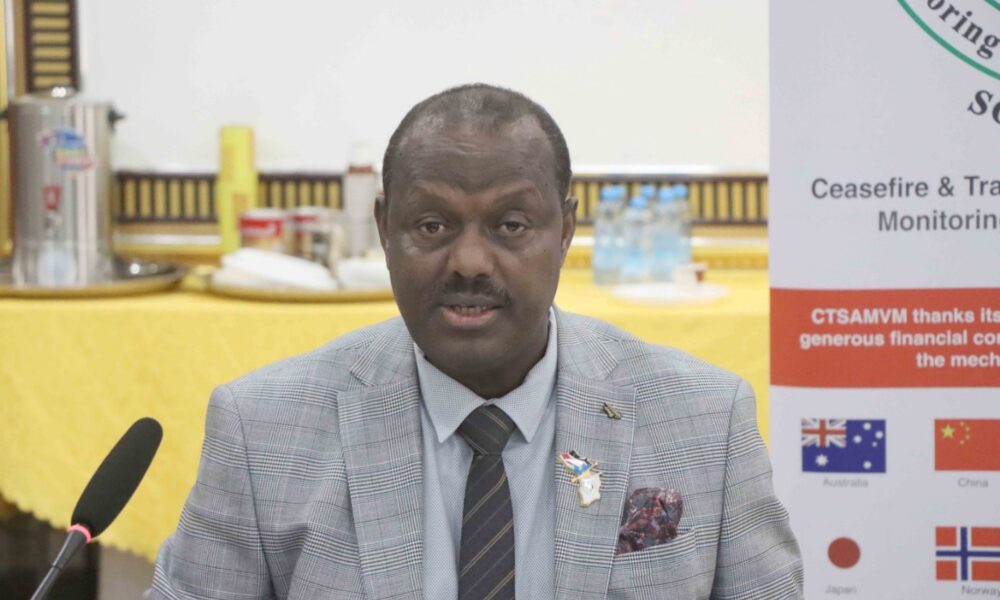
Speaking during the 53rd board meeting yesterday, Maj. Gen. Teshome Anagawe Ayana, Chairperson of the CTSAMVM said the Permanent Ceasefire framework is under great threat with most parts of the country seeing widespread fighting.
Recent reports from local authorities, military commanders and community representatives in Jonglei and Upper Nile indicate a sustained pattern of hostilities characterised by a battle for presence and influence over territory.
“CTSAMVM respectfully encourages all signatory parties and relevant mechanisms to reaffirm their commitment to the Permanent Ceasefire and to extend full institutional support to monitoring and verification processes” he stated in his opening remark.
Anagawe noted the impact on civilians cannot be overstated, with killings, injuries, sexual violence, displacement and severe movement restrictions caused by the ongoing hostilities.
He stressed that these dynamics underscored the importance of accelerating disengagement, cantonment, and unification processes, adding that protection of civilians remains a central concern.
According him, reports of aerial bombardments in civilian areas, incidents involving humanitarian personnel in Nasir and Koat Payam, and cases of ambushes, abductions, looting, and market attacks highlight the vulnerability of local security conditions.
“Disruptions along river transport corridors have contributed to economic strain and food insecurity, while displacement of more than 8,000 individuals from Ayod and Nyirol Counties illustrates the humanitarian impact of localized instability” he added.
Anagawe underlined that sexual and Gender-Based Violence remains a grave concern, and the clear prohibition outlined in Article 2.1.10.3 of the Agreement called for ongoing monitoring, prevention, and accountability by all signatory parties.
He further added that Humanitarian access and freedom of movement are also of concern adding that recent attacks on health centres and humanitarian workers are unacceptable and must be condemned.
“Informal restrictions continue to affect civilian mobility and movement between areas under the control of different forces remains difficult” he said.
While parts of Central Equatoria remained relatively stable, Upper Nile and sections of Jonglei experienced deterioration marked by armed confrontations, civilian casualties, intercommunal fighting, and disruptions to humanitarian aid operations.
Anagawe underscored that hostilities also escalated in Longochuk and parts of Maban County, with ongoing engagements affecting civilians and constraining movement.
According to him, Ulang County experienced sustained violence resulting in fatalities, injuries, and destruction of civilian property, with investigations requested by local authorities.
He also emphasized that intercommunal tensions in Malakal and surrounding areas have intensified, highlighting the growing overlap between political, military, and communal grievances.
Anagawe highlighted that the peace process is under extreme pressure as per the assessment shared not only by CTSAMVM, but by the wider international community, analysts, and regional stakeholders.
“It is imperative that the parties’ step back from confrontation and recommit to dialogue. We are pleased to see the participation of Revitalized Transitional Government of National Unity (RTGoNU) in recent diplomatic efforts” he stressed.