

By Kei Emmanuel Duku
Wildlife authorities have declared a massive crackdown on the River Nile, warning boat operators that their vessels will be seized and held indefinitely if found transporting illegal animal products.
Col. John Chol Adui, the Wildlife Operations Commander for the South Sudan Wildlife Service, revealed that the Nile has become a primary fresh water body connecting Juba and Bor for the smuggling of commercial bush meat, ivory, and leopard skins.
The move comes as the Ministry of Wildlife Conservation and Tourism launches coordinated operations across the country’s six national parks, including Boma and Badingilo, to dismantle trade routes used by poachers.
“We have also realized that some poachers use boats to now transport the wildlife through the Nile either to Juba or Rumbek in Lakes State and soon we are starting operations on the Nile to crack down on these illegal wildlife trade routes,” Col. Adui stated, noting that most of the bush meat originates from Bor before being trafficked to Lakes State or Central Equatoria.
The Commander issued a stern ultimatum to the maritime community regarding the legal consequences of aiding traffickers.
“The common wildlife species trafficked through the Nile includes commercial bush meat, ivory, leopard skin—all are being trafficked through the Nile, so the boat operators are warned,” Col. Adui declared.
He clarified that in the event that wildlife forces seize any marine vessel carrying wild meat or any species of animal, “the boat will be confiscated till investigation is completed before releasing the boat after the court has finalized with the court process.”
To enforce this directive, the Ministry has prepared a fleet of eight marine vessels, each capable of carrying 20 rangers. While the Ministry currently has 104 forces deployed in Bor, Col. Adui admitted this is small compared to over 1,000 illegal poachers in the area.
Ideally, he noted, an operation task force should have 2,000 to 3,000 rangers to counter such numbers. “The issue of Jonglei is now too much, that is why the ministry has intensified its operation in the area,” he said, adding that there are plans to recall and redeploy forces from Central, Eastern, and Western Equatoria, as well as Upper Nile and the Bahr el Ghazal region, to combat the high rate of poaching triggered by Juba’s high demand for meat.
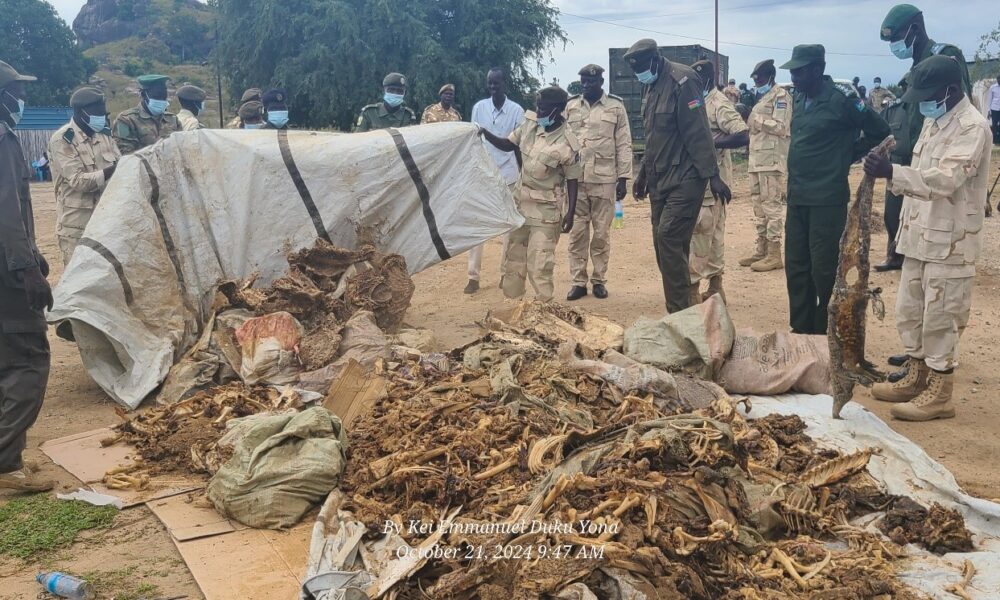
The scale of the illicit trade is immense, with 54 wildlife crimes registered since the start of 2026. On the Juba-Bor highway, a special “Tiang Taskforce” recently intercepted 1,700 kg of bush meat on March 27, followed by another midnight seizure on March 28 at Kerikedia.
The second vehicle was found carrying the meat of a tiger, weighing 896 kg, bringing the two-day total to nearly one ton.
High prices drive the slaughter; residents report that a single wild animal can fetch 500,000 Pounds or 100 dollars. “Currently if you go to Bor town, at least you can see a boda boda rider carrying about six herds of wild animals which is equal to about 3 million pounds,” Adui noted.
Laura Tete, the Director General of Tourism at the Ministry of Wildlife Conservation and Tourism, emphasized that these animals and their habitats are the backbone of a sector that could rival the oil industry. “If there is stability in South Sudan, We shall not suffer because they say tourism is next to oil,” she stated, highlighting the potential for bird watching in the Sudd and elephant conservation in the forests of Yambio.
She warned that illegal logging and deforestation are destroying these habitats, suggesting that the Minister of Environment should implement a policy where “when you cut one tree, you must plant two,” to ensure animals do not suffer habitant loss.
“Every part of South Sudan is green, particularly Juba. How God blessed us in terms of natural resources, in terms of tourism potential is amazing,” Tete added, listing water rafting, spot fishing, and religious tourism at historical sites like Rajaf as simple but untapped opportunities.
Echoing the importance of surface resources, the French Ambassador to South Sudan, Philippe Michel Kleibauer, underscored that both farming and wildlife are sustainable resources unlike oil.
He argued that it is vital to protect wildlife for children who want to visit parks for study and recreation. “Under the ground it is a very short term, its 50 years maximum, but protecting the wildlife and farming is for decades to decades because it can create employment,” the Ambassador stated.
He concluded that stakeholders must protect nonpolitical wildlife species so they should “be protected to gain their freedom,” moving the focus away from underground resources that will not last more than fifty years.