

By Lodu William Odiya
In a move to back South Sudan’s elections in December this year, Russia has pledged electoral training in Moscow.
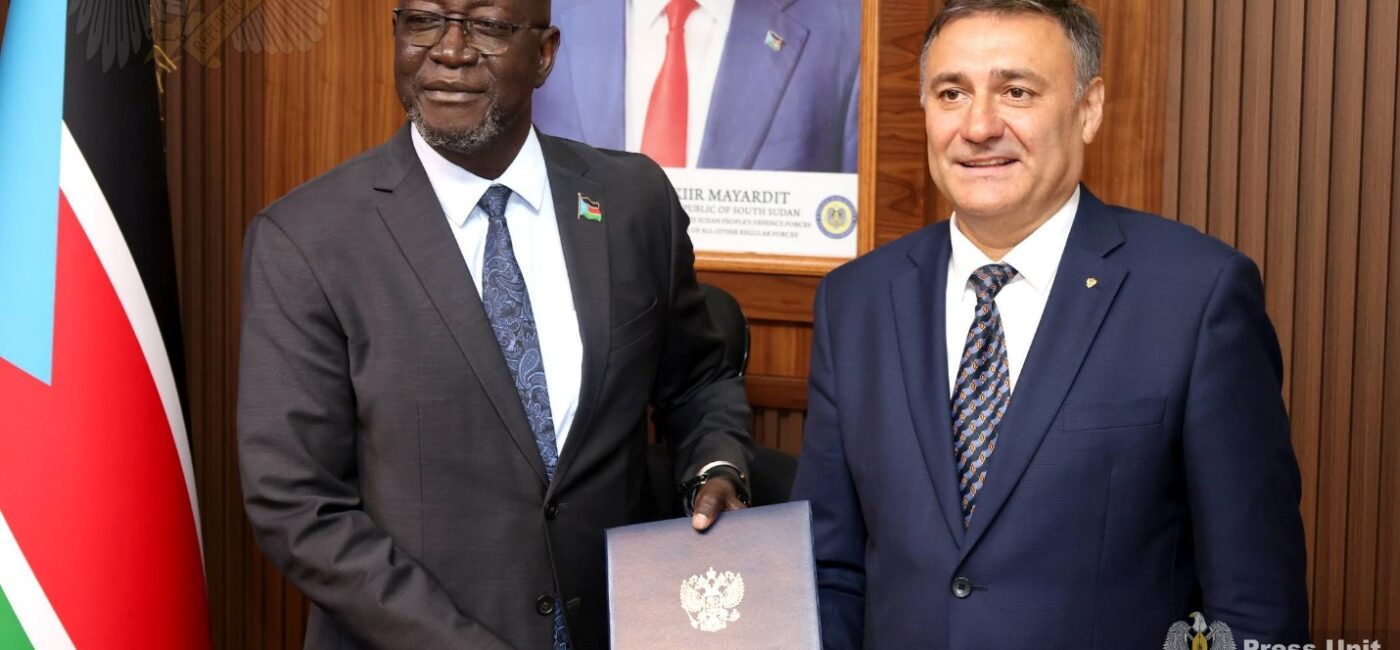
According to the presidential press unit, Minister of Presidential Affairs Africano Mande Gedima received Russian Ambassador Aleksandr Kosmodemyansky to review bilateral relations between Juba and Moscow.
In the statement, Ambassador Mande described the ties as constructive, grounded in mutual respect, sovereignty, and non-interference.
“He reaffirmed Russia’s full support for South Sudan’s December elections and confirmed that South Sudanese electoral officials will undergo training in Russia,” the statement partly read.
Moscow also expressed readiness to expand political, business, and cultural engagement.
The press unit also underscored that the presidential press secretary, Arek Aldo Ajou, welcomed the commitment, noting discussions also covered economic development and investment opportunities.
After years of delays, South Sudan is prepared to hold elections in December, despite the nation being on the brink of civil war.
Experts are warning of a return to full-blown war as government forces under the president fight groups loosely aligned with the vice president.
The violence has forced tens of thousands to flee their homes, with aid agencies regularly attacked and struggling to function.
A peace deal in 2018 put an end to the last civil war between President Salva Kiir and the suspended First Vice President, Riek Machar.
During a Tuesday press briefing, the minister of information, communication technology, and postal services, Ateny Wek Ateny, pushed back against reports that the current administration had quietly prolonged its mandate, insisting that the timeline agreed upon by President Salva Kiir and the Council of Ministers remains unchanged.
“There is no further extension. Elections must take place at the end of 2026,” Ateny told reporters in Juba, describing the government as prepared to proceed with the vote.
His remarks come at a time of heightened scrutiny over South Sudan’s transition, with previous deadlines having been missed and key provisions of the peace agreement, including the permanent constitution-making, still unimplemented.
Ateny said the administration is already looking toward the final stages of the transition, including the possibility of a caretaker government in the months leading up to the polls.
Under such an arrangement, the current government would limit its role largely to overseeing the electoral process.
“If it is two months before the end, then we now remain with less than six months to ensure that the government becomes a caretaker government,” he said, pointing to October 2026 as a potential starting point.
The government’s clarification follows confusion triggered by a recent cabinet decision, which some interpreted as an attempt to extend the transitional period. Ateny rejected that interpretation, saying the Council of Ministers had only approved a legal step to allow lawmakers to debate proposed amendments to the Revitalised Peace Agreement on the Resolution of Conflict 2018.