

By Yang Ater Yang
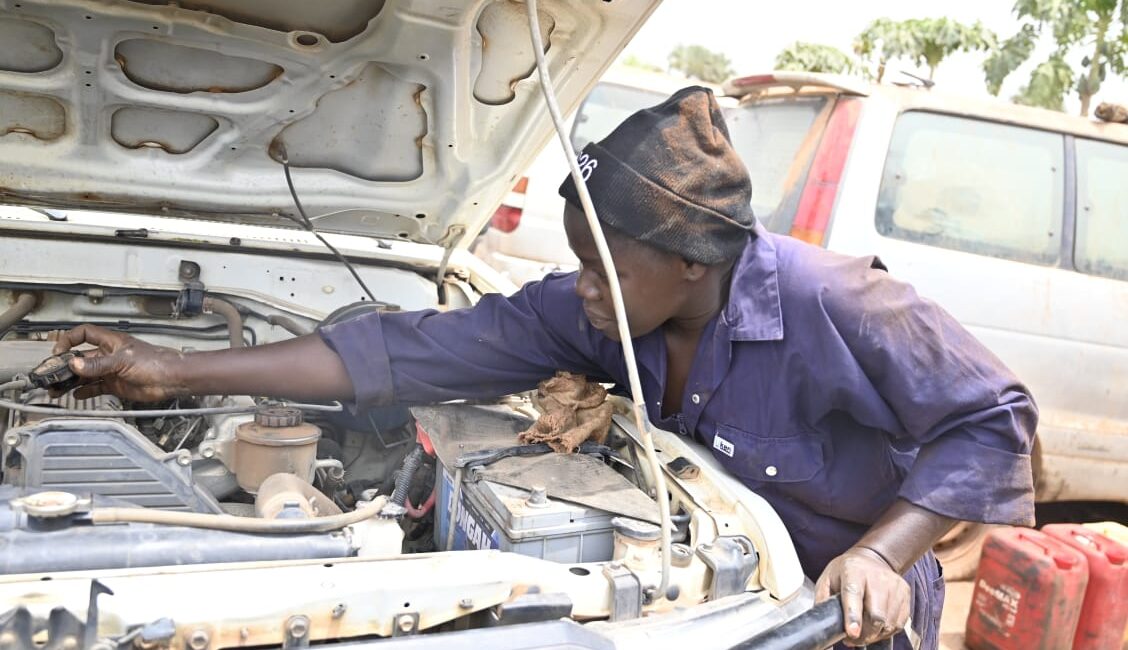
Rebecca Nyibol Malual, a 25-year-old woman from Wulu County, is challenging traditional gender roles by working as a mechanic while supporting her child and family through skills she acquired at the St. Peter Claver Computer and Ecological Training Centre in Rumbek.
Rebecca currently works at a car service garage along Rumbek Airport Road. She said she enrolled in a combined mechanics and driving course at the Catholic-based vocational training centre after completing her secondary education.
According to Rebecca, the training lasted 16 weeks, including 10 weeks of mechanics and six weeks of driving.
“I faced many challenges during the course, but because I loved mechanics, I continued,” she said.
Rebecca explained that finding employment has become increasingly difficult for young people, even after completing secondary school or university education.
“I decided to study mechanics and driving so that if I do not find a driving job, I can use my hands and skills to earn a living,” she said.
Rebecca completed Senior Four during the 2024–2025 academic year but did not proceed to university. As a single mother, she said the responsibility of caring for her son motivated her to pursue vocational training.
“I have a son, and I am responsible for taking care of him. I wanted him to go to school, and I also needed to support myself. That is why I chose this course,” she said.
She noted that learning mechanics has transformed her life financially and personally.
“Since I completed the course, many things have changed. I have taken my son to school, and the money I earn helps me meet my needs. Before, I depended on my parents and relatives, but now I can support myself,” she said.
Rebecca added that she is now able to contribute to family needs whenever necessary.
“If there is a problem in the family, I can help because I have my own income,” she said.
She said that her dream since Senior One has been to become a professional driver. However, she later realised the importance of combining driving with mechanical skills.
“It is better for me to have both professions. If I do not get a driving job, I can work in a garage using my mechanical skills,” she explained.
Rebecca said she can perform several mechanical tasks, including repairing brakes, changing tyres, replacing brake shoes, servicing vehicles, and changing engine oil.
She explained that her income varies depending on the amount of work available.
“If there is a lot of work, I can earn more than 100,000 South Sudanese Pounds (SSP). When work is limited, and I am only changing oil or doing simple tasks, I may earn between 20,000 and 30,000 SSP,” she said.
The income has enabled her to pay her son’s school fees and improve her family’s living conditions.
“My parents have seen the change in my life, and they are happy. I have been able to improve many things for myself and my family,” she said.
Rebecca encouraged parents across Lakes State to allow their daughters to pursue technical and vocational careers, including mechanics and driving.
“When I was studying mechanics and driving at St. Peter Claver, there were only five girls in the class, while the rest were boys,” she said.
After graduating, Rebecca secured an opportunity to gain practical experience at a local garage, where she was welcomed and given the chance to work.
“I graduated, started my practical training, and was accepted at the garage. Now everything has changed in my life,” she said.
Rebecca’s story highlights how vocational skills training is helping young women in South Sudan create employment opportunities, support their families, and break barriers in traditionally male-dominated professions.