

By Sabri Dibaco
The government of South Sudan has received the final consignment of emergency food assistance from the People’s Republic of China.
This completed a donation of 3,256 metric tons of rice and wheat intended to support thousands of vulnerable people affected across the country.
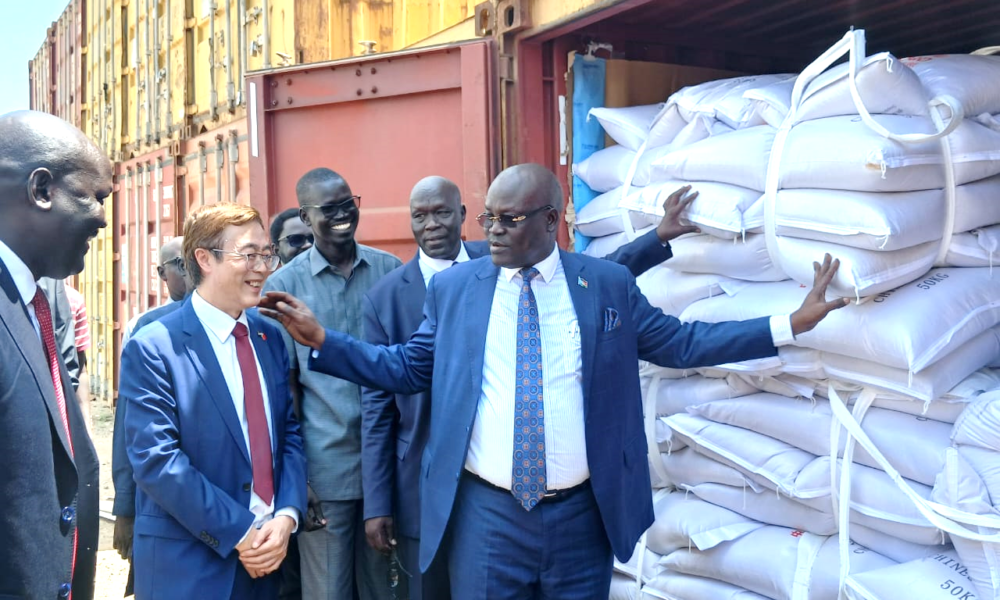
The handover ceremony, held in Juba, marked the delivery of the last 37 containers out of a total of 148 containers of food aid, comprising 74 containers of rice and 74 containers of wheat.
Speaking during the ceremony, William Chan, undersecretary in the Ministry of Humanitarian Affairs and Disaster Management, said the donation reflects the strong partnership between South Sudan and China and will provide much-needed relief to vulnerable communities.
“On behalf of the government, the leadership of the Ministry of Humanitarian Affairs, and the people of South Sudan, I would like to extend our sincere appreciation to the government of China for its continued friendship, solidarity, and unwavering support to the people of South Sudan at a time when many communities continue to face food shortages and other humanitarian challenges,” Chan said.
He explained that the latest shipment completes two consignments of wheat totalling 1,628 metric tonnes and two consignments of rice amounting to 1,628 metric tonnes, bringing the overall donation to 3,256 metric tonnes.
According to Chan, the food assistance will be distributed to returnees, internally displaced persons (IDPs), flood-affected communities, persons with disabilities, and other vulnerable households across South Sudan.
“The Ministry of Humanitarian Affairs and Disaster Management and the Relief and Rehabilitation Commission remain committed to ensuring that this donation is managed with transparency, accountability and efficiency so that it reaches the intended beneficiaries and delivers the greatest possible impact,” Chan added.
He further noted that South Sudan looks forward to expanding cooperation with China beyond humanitarian assistance into agriculture, food security, infrastructure, health, education, and economic development.
Addressing the gathering, Chinese Ambassador Ma Qiang said the food assistance demonstrates China’s commitment to supporting South Sudan during difficult times and fulfils commitments made under the 2024 Beijing Summit of the Forum on China-Africa Cooperation (FOCAC).
“In early July 2026, the 3,256 metric tonnes of rice and wheat provided by China had all been delivered to Juba. This food assistance marks a key step in implementing the 10 partnership actions unveiled at the 2024 Beijing Summit of the Forum on China-Africa Cooperation,” Ambassador Ma said.
The ambassador said China understands the humanitarian challenges facing South Sudan, particularly the impact of recurring floods and food insecurity.
He emphasised that China had coordinated closely with the South Sudanese government to ensure the timely delivery of all four batches of food assistance.
“With the smooth handover of the fourth and final batch of food aid, China’s firm commitment to honouring its promises and delivering on its words has once again been powerfully proved,” Ma stated.
The ambassador also highlighted China’s broader development cooperation with South Sudan, saying Beijing’s support extends beyond emergency aid.
According to the ambassador, China has supported South Sudan through the construction of hospitals, schools, water supply systems, roads, technical cooperation, and capacity-building programs.
He disclosed that since 2012, more than 5,000 South Sudanese officials, technical personnel, and students have received training and scholarships in China, including programs focusing on agriculture.
The ceremony was attended by Minister of Humanitarian Affairs and Disaster Management Albino Akol Atak, Relief and Rehabilitation Commission Chairperson Stephen Kwid Gatluak, officials from the Ministry of Foreign Affairs and International Cooperation, representatives of the Chinese Embassy and members of the media.
South Sudan continues to face one of the world’s most severe humanitarian crises, driven by recurrent flooding, localised conflict, displacement and economic challenges.
According to humanitarian agencies, millions of people across the country require food assistance each year, with returnees and internally displaced persons among the most vulnerable.