



By Ngor Deng Matem
Farmers across Aweil are facing the prospect of a poor harvest this year as erratic rainfall and extended dry spells between rains continue to damage crops, with Aweil East and Aweil South counties emerging as the hardest-hit areas.
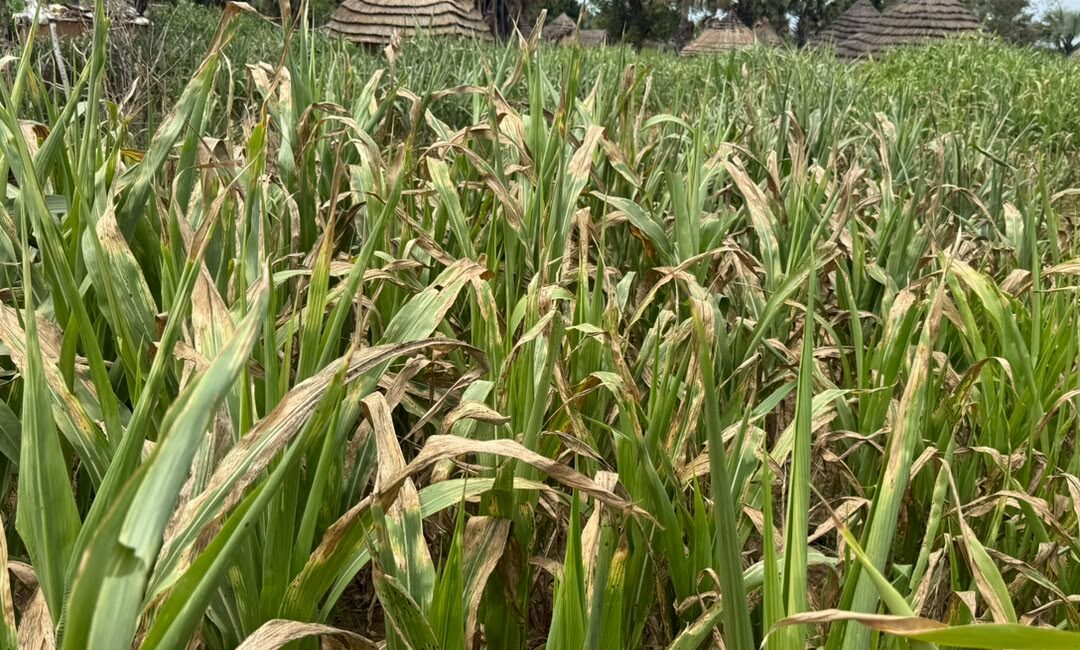
Across the region, maize, sorghum, and groundnuts are withering before reaching maturity after rainfall repeatedly stopped for weeks during the growing season. Fields that initially showed promising growth have turned yellow and dry, leaving many farmers uncertain about their food supply in the months ahead.
Gabriel Garang, a farmer from Wanyjok in Aweil East County, said the unpredictable weather has dashed hopes of a successful harvest.
“We planted on time after the first rains, but the rain stopped for many days. Our crops are now drying before producing grain. I no longer believe we will get a good harvest this season,” he said.
In Majakakoon, also in Aweil East County, farmer Bakhita Abuk Garang said the situation has affected nearly every farming household in her community.
“The crops started well, but the long dry spells between the rains have destroyed them. We are losing hope because our farms are no longer giving us the yield we expected. Many families are worried about what they will eat,” she said.
Similar concerns were echoed in neighbouring Aweil South County, where Deng Mel Yel, a farmer from Wathmuok, described the season as one of the most difficult in recent years.
“Rain comes once and then disappears for many days. The crops stop growing and begin to dry. We have worked hard throughout the season, but we now expect very little from our farms,” he said.
Farmers say Aweil East and Aweil South have experienced some of the most severe impacts of the irregular rainfall, with large sections of farmland showing signs of moisture stress, including dried stalks, yellowing leaves, and stunted crops.
The deteriorating condition of crops has heightened fears of reduced food production and increased food insecurity in a region where most households rely on rain-fed agriculture for both food and income.
Harvests in Northern Bahr el Ghazal typically take place between September and October each year. However, farmers fear that unless consistent rainfall resumes in the coming weeks, this year’s harvest could be significantly below normal, leaving many households vulnerable to food shortages.