


By Sabri Dibaco
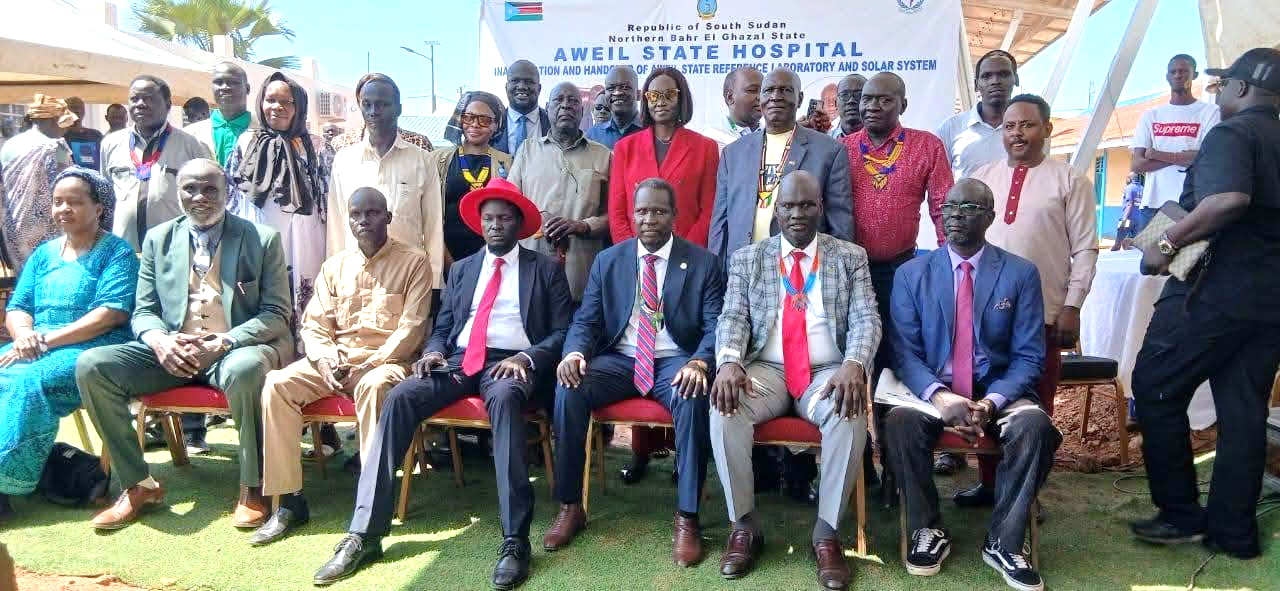
The Government of South Sudan and the United Nations Development Programme (UNDP) have officially inaugurated a new Aweil State Reference Laboratory, a large-scale solar power system, and a specialised medical incinerator in Northern Bahr el Ghazal State, marking a major investment in strengthening the country’s public health infrastructure.
The project, valued at more than US$1.6 million (approximately US$1.7 million), was financed through the Global Fund COVID-19 Response Mechanism (C19RM) and is expected to improve laboratory services, disease surveillance, emergency preparedness, and healthcare waste management in the region.
Speaking during the launch, UNDP Deputy Resident Representative for Programmes Sheila Ngatia described the facility as a strategic investment in South Sudan’s health sector.
“Today, we celebrate more than the opening of a new building. We celebrate a strategic investment in South Sudan’s health security, resilience, and sustainable development,” Ngatia said.
She noted that the state-of-the-art laboratory represents an investment of more than US$1.6 million aimed at strengthening laboratory services, disease surveillance, and emergency preparedness.
“As the principal recipient of the Global Fund grants in South Sudan, UNDP remains committed to supporting the government in building resilient health systems that can respond effectively to both routine health needs and public health emergencies,” she added.
National Minister of Health Dr. Luke Thompson Teny Thoan said the establishment of the laboratory reflects the country’s growing stability and the government’s commitment to expanding quality health services beyond the capital.
“This milestone reflects the stability and peace we continue to foster in Northern Bahr el Ghazal, a peace that influenced our decision to locate these critical investments here in Aweil,” Thompson said.
The minister praised UNDP for successfully delivering the project and urged government institutions at both national and local levels to ensure the facility is properly maintained. “UNDP has honoured its responsibility completely, delivering this facility to 100 per cent of what was expected. Now, the fundamental responsibility shifts to us. As the Ministry of Health, our duty is to sustain this facility, while the ultimate stewardship rests with the local government and leadership of Mading Aweil,” he stated.
Dr. Luke added that strengthening government institutions remains essential to enable them to manage development resources directly in the future.
The Undersecretary in the Ministry of Health Dr. Francis Oromo Seriano, described the project as a historic achievement, saying the new laboratory surpasses the size of the National Public Health Laboratory in Juba.
“We are marking a historic moment today. The Aweil Reference Laboratory is even larger in scale than our National Public Health Laboratory in Juba, complemented by a massive solar installation and specialised medical incinerator,” he said.
He explained that Aweil was strategically selected because of its location along the country’s northern transport corridor, making it critical for monitoring cross-border disease threats.
“Diseases do not ask for permission, and they do not respect borders; they simply arrive. Because this facility sits along an active corridor with high population movement, it will serve as an essential defense shield,” Dr. Francis said.
He added that beyond disease diagnosis, the laboratory will also support universities and regional research institutions. Oromo also revealed that the government is already implementing a similar laboratory project in Yambio.
Northern Bahr el Ghazal State Minister of Health Dr. Riiny Riiny Lual welcomed the investment, saying the solar power system will guarantee uninterrupted healthcare services at Aweil State Hospital.
“This major investment ensures reliable, uninterrupted power, minimising clinical disruptions and guaranteeing 24-hour delivery of essential health services at Aweil State Hospital,” he said.
Riiny also commended the installation of the specialised medical incinerator, emphasising that safe disposal of healthcare waste is vital for infection prevention, environmental protection, and improving the quality of healthcare services.
The newly inaugurated facility is expected to enhance South Sudan’s capacity to detect and respond to disease outbreaks, strengthen research and laboratory diagnostics, and improve healthcare delivery in Northern Bahr el Ghazal and neighbouring regions as part of broader efforts to build resilient health systems nationwide.