


By Sabri Dibaco
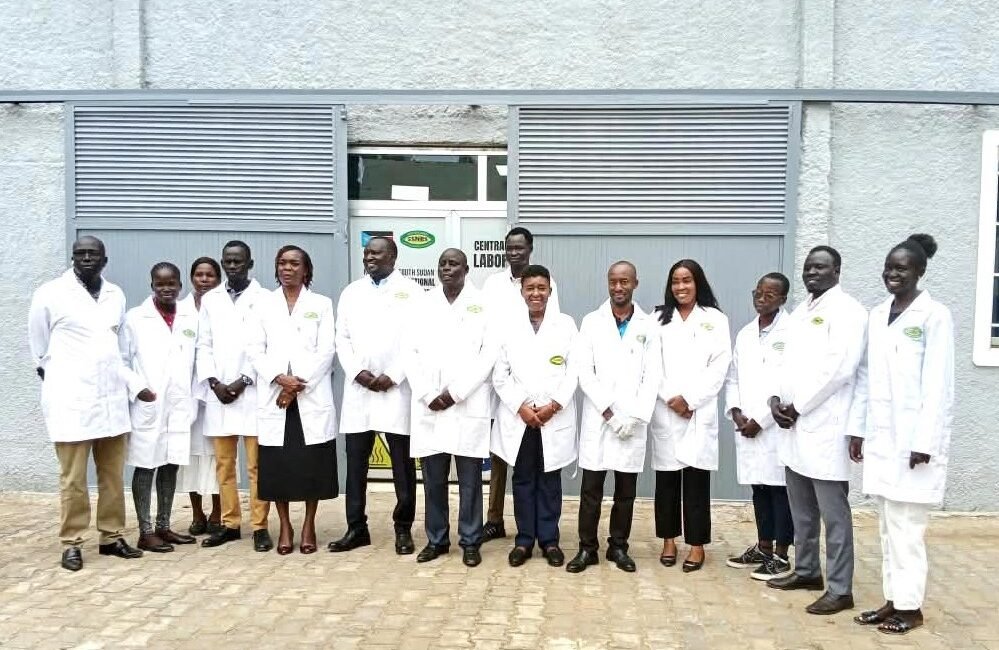
The South Sudan National Bureau of Standards (SSNBS) said the renovation and equipping of its central laboratory will speed up product certification by allowing more testing to be conducted inside the country.
According to the Bureau, the laboratory upgrade is expected to address one of the biggest challenges facing the Bureau’s Certification and Export Department and the need to send product samples abroad for tests that could not previously be conducted locally.
Naima Samson-Goma, Director of Certification and Export at the Bureau, said the renovated laboratory is already improving the certification process.
“I’m happy to see what is happening, because it is a direct effect on the Department of Certification and Export,” Samson-Goma said.
She said that before the renovation and installation of new equipment, the Bureau could not test all the required parameters for products seeking certification, adding that samples had to be sent to laboratories outside the country, which takes lengthy delays.
“Sometimes we receive the result after two months, sometimes after three months,” Samson-Goma said.
According to her, delays occurred because foreign laboratories were handling samples from different countries and had to process them according to their existing workload.
The upgraded laboratory is now equipped to conduct a wider range of tests, reducing the need to send samples abroad.
Samson-Goma said the Bureau recently audited about 25 companies, with their samples now being tested locally.
“Our lab is able to test it. We request the invoice, they send us the invoice, and now they even start the testing,” she said.
She expected some of the results to be available within weeks, allowing the certification process to move much faster.
The Bureau previously faced delays of up to three months when waiting for external laboratory results.
Samson-Goma underscored that the target is now to complete certification within approximately one month, depending on the type of testing required.
“For some of the micro, microbiological tests, it may take two to three weeks for the result to be out,” she explained.
Samson-Goma said the certification mark allows consumers to distinguish products that have been assessed and certified by the national standards authority.
“The public will know that this product has been certified, and it is according to the standard requirements,” she said.
The certification process involves assessing products against applicable standards and testing samples to establish whether they meet the required specifications.
The renovated laboratory is therefore expected to become a critical part of the certification system, providing the technical testing needed before the Bureau can approve products.
The Bureau says the laboratory previously lacked equipment needed to test some important parameters.
Samson Goma said the facility can now test heavy metals, including iron and copper, as well as sugar content and fatty acids in products.
“We have other equipment where we can be able to test not only the heavy metals; now we are able to even test the sugar, the quantity of sugar in the product, and we are able to test the fatty acid in the product,” she said.
For manufacturers, the previous system meant additional costs and uncertainty because samples had to be transported outside the country for testing.
Samson-Goma said the change will make the work of the Certification and Export Department easier because certification can proceed once the laboratory produces the required test results.
“This one will make our work very easy in the certification department, so we will be able to certify the companies on time,” she said.
The head of the National Metrology Laboratory, Henry Redento, said the expanded laboratory capacity must be supported by accurate measurement and calibration.
“All this equipment, you can do a test. But how accurate is the result that you’re giving?”
Redento explained that metrology is responsible for ensuring that laboratory and commercial measurement equipment produces reliable results through regular calibration.
He said accurate measurements are particularly important for businesses dealing in products sold by weight, volume, or length.
“If you’re selling kg, or you’re selling volume, or you’re selling length, those measurements need to be confirmed by the metrology,” he said.
With more testing now available locally, manufacturers can potentially avoid the long waiting periods associated with overseas testing, while consumers can have greater confidence in products carrying the national quality mark.
The renovation is therefore more than an infrastructure upgrade, but it was intended to strengthen the entire certification chain from product inspection and laboratory testing to certification and eventual access to regional and international markets.