


By Lodu William Odiya
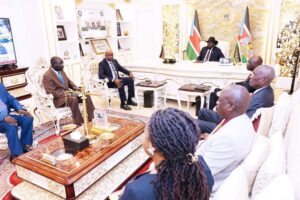
The South Sudan Ad Hoc Border Committee has briefed President Salva Kiir Mayardit on its recent engagements with neighboring countries.
The engagement between the countries includes, Kenya, Uganda, and the Democratic Republic of Congo, regarding the settlement of disputed border areas.
In a statement released by the presidential press unit, the press secretary Ambassador David Amour said that the committee updated the Head of State on progress made through diplomatic consultations.
“The committee updated the Head of State on progress made through diplomatic consultations and technical assessments aimed at fostering peaceful coexistence and strengthening bilateral relations” the statement partly read.
Tensions along the contested border between South Sudan and Uganda escalated on July 28, 2025, when forces from both countries reportedly engaged in armed confrontations near Kajo-Keji County in Central Equatoria State.
Tensions between South Sudan and Uganda have persisted for years, rooted in contested border demarcations in Magwi and Kajo Keji counties, with prior deadly incidents dating back to 2020 and 2024.
In early March 2025, Uganda deployed special forces to help secure South Sudan amid internal unrest involving President Salva Kiir and Vice President Riek Machar. That deployment heightened the potential for friction along poorly defined frontiers.
Residents are sheltering in schools, churches, and bush camps across both sides of the border, as authorities struggle to contain violence and mitigate refugee flows.
South Sudanese and Ugandan leaders have initiated diplomatic engagement. On-site commanders have been instructed to avoid further escalation, and investigations are underway to determine the origins and responsibility for the skirmishes.
These clashes threaten to inflame a broader security crisis in a region already fragile from internal conflict, refugee crises, and economic strain.