




By Kei Emmanuel Duku
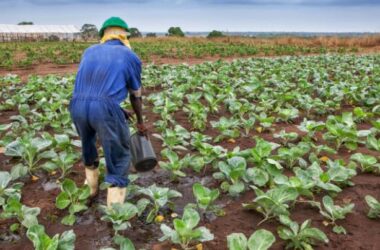
Local food producers across South Sudan are issuing a desperate cry for help, warning that the combination of outdated farming tools and crippling government taxes is severely controlling local output and ensuring the nation remains dangerously dependent on costly food imports.
Agricultural leaders state that without urgent government intervention to harmonize taxes and incentivize mechanization; the price of locally grown food will always be undercut by cheaper foreign goods.
Christopher Ismail, the CEO and founder of Eden Multipurpose Marketing and Cooperative in Yambio, Western Equatorial State, detailed the fundamental challenges his cooperative faces.
“The challenge we are facing is that we are still using basic tools for farming,” Ismail stated. “This does not enable us to produce in big quantities so that we can compete in the bigger market.”
He stressed that the manual labor involved cutting trees and digging with holes is “hectic,” resulting in minimal profit margins. Ismail argued that mechanizing production is the only way to generate a larger yield that can be milled and sold across South Sudan.
While his cooperative, through a partnership with the “2 SCALE” project, has moved from selling raw grain (often to partners like WFP and PG3 Logistics for programs like school feeding, food to IDP’s and refugees) to processing maize into flour, their capacity is severely limited.
Ismail explained that the current milling machine only produces one metric ton (1,000 kilos) per day, underscoring the need for a bigger machine capable of 10 to 15 metric tons per day to truly scale up.
The CEO highlighted that value addition is crucial, as it helps increase income and resolves the “risky” challenge of storing perishable raw maize for long periods.
However, the cost of moving these value-added goods is devastating. “It is not easy taking produce from Yambio to these other locations- like Juba due to bad road network condition. And also, we suffer high tax from the government,” he lamented.
He explained that this excessive taxation, even between local administrative areas (Payams), actively discourages new farmers.
“If farmers are highly taxed, our local produce becomes expensive compared to the imported one,” Ismail warned. Their production cost is lower than ours because they are mechanized. When they are bought locally, you find that imported maize flour is cheaper than our local one because they are produced cheaply” he said.
Ismail strongly appealed for government action. “We need the government to provide some incentives that can motivate farmers to produce in large scale. We must harmonize tax on food items and on agro-inputs like hoes!”
He insisted the government must give “special consideration for farm produce which is produced locally so that we avoid this issue of over-dependence on import from outside South Sudan, which is actually not helping us, the locals.”
The cooperative sells its processed maize flour packaged in various sizes, with the 50-kilogram bag selling at 45,000–50,000 Pounds, making it competitively priced against imported maize flour from Uganda.
Innocent Michael Lumori, Beneka Modern Farms Operations Manager, highlighted similar economic pressures facing the livestock sector.
In the farm’s three years of existence, they have battled numerous hurdles, including high financing costs, the high cost of formulating and buying poultry feeds, and disease outbreaks exacerbated by climate change.
To minimize the “high cost of exporting agro-inputs and government taxes,” Michael’s farm has resorted to innovative, local solutions.
“We decided to cut costs by formulating our own local feeds for the poultry and piggery from locally available produce such as millet, cowpeas, sorghum, and maize, instead of importing,” Michael stated.
The farm also relies on local organic herbs Moringa Leaves, lemon, ginger, and onions for treating their 2,000 Sassuo breeds of birds and 100-layer birds, pigs, guinea pigs, and rabbits.
“We even use the urine of the rabbits as pesticide and to help in treating or curing diseases. Those are all the organic treatments we incorporate in our farm,” he added.
Michael argued that despite the high cost of starting and sustaining the business, the venture is profitable due to the high demand for white meat (like rabbit) preferred by consumers with specific health conditions (Diabetes and High blood pressure)
“We are currently fighting food security issues,” he explained. “For people who have been advised not to eat other kinds of meat, we advise them to eat rabbit. It’s health-wise clean and free from diseases; above all, it is white meat.”
Sida Josephine, Production Officer at Hagana Agro Processing Company Limited, which produces honey and peanut butter, confirmed the crippling effects of poor logistics and taxation on processors.
“Our biggest challenge is during the sourcing of raw materials: high cost of transportation is a problem, and multiple taxes are imposed by various arms of the government,” Josephine revealed.
The company sources honey from Western and Eastern Equatoria States, sometimes even from Uganda. She explained that the journey is littered with cost additions.
“When we’re bringing our raw materials from the field, there are a lot of roadblocks. When you add the cost of production, the end price is high for the ordinary consumer.”
To lower costs, the company bought a generator to counter high electricity consumption and worked with suppliers who understand the security checkpoints.
“We now actually work with people who know the behaviors of those security officers at the roadblocks. These suppliers sometimes avoid some of the taxes which an ordinary person would have paid throughout the road,” she said, acknowledging that this system helps them “cut actually some of the expenses that were” she incurred.
Despite possessing vast, fertile land, South Sudan’s agriculture is constrained by a pervasive reliance on subsistence farming using rudimentary tools, leading to low yields and quality.
The critical challenge lies in the lack of public investment in infrastructure, specifically the country’s limited network of all-weather roads, which increases transport costs and limits market access for farmers. Furthermore, the practice of multiple, unharmonized taxation and levying at various state and county checkpoints significantly raises the cost of local produce.
This combination of low mechanized efficiency and high logistical costs ensures that local food is often priced higher than cheaper, often subsidized, imports, sustaining the nation’s severe food import dependency.