


By Kei Emmanuel Duku
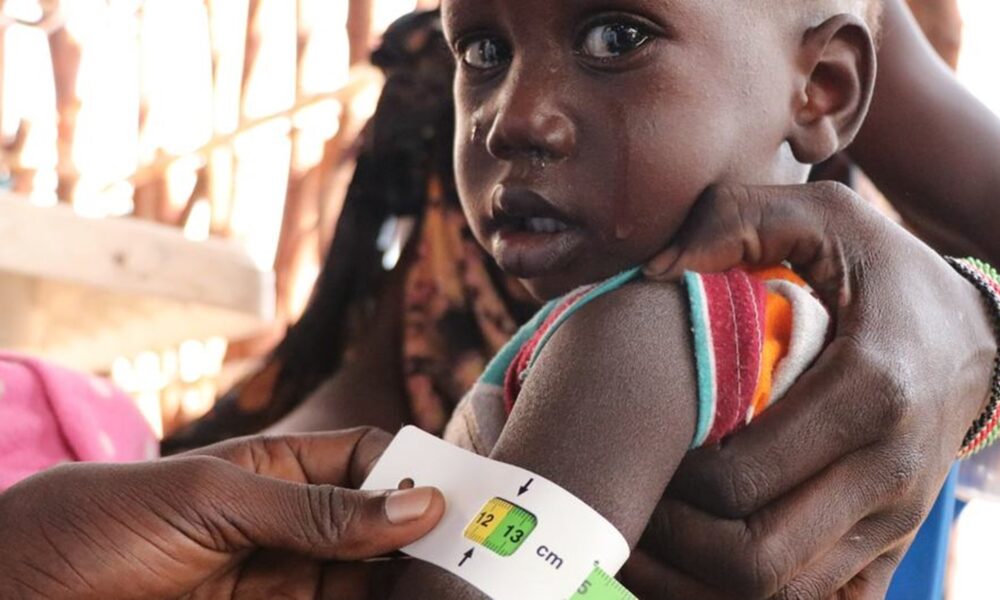
South Sudan is staring down a huge humanitarian tragedy, with 3.2 million children and pregnant/lactating women projected to suffer from acute malnutrition by mid-2026, according to stark new figures released during the launch of the country’s Integrated Food Security Phase Classification (IPC) analysis.
The alarming statistics were unveiled by South Sudan’s Minister of Agriculture and Food Security, Hussein Abdelagi Akol Agany. The Minister confirmed that the crisis requires an “urgent nutrition support” response, noting that approximately 70 percent of this massive burden is concentrated in five states of Jonglei, Northern Bahr el Ghazal, Upper Nile, Unity, and Warrap.
“The underlying causes of this food insecurity and malnutrition are multi-faceted, and tragically interconnected,” Minister Agany stated. “Conflict and insecurity continue to displace households, disrupt vital agricultural activities, and critically restrict humanitarian operations.”
The report painted a grim picture of interwoven threats where he highlighted that the nation’s economic instability, marked by high inflation and declining household purchasing power, has severely cut off access to food and essential goods. This is compounded by devastating climate shocks, including recurrent floods, which have destroyed crops, livestock, and infrastructure.
Ismail Kamil, UNICEF Deputy Representative, painted a worrying picture, stating that 2.1 million children under 5 and 1.1 million pregnant and breastfeeding women are projected to be acutely malnourished between July 2025 and June 2026. This includes 670,000 children suffering from the most severe form of malnutrition.
“All need urgent treatment,” Kamil stressed. “There are children failing to survive. Mothers skipping meals, and communities stretched beyond their coping capacities.”
The crisis is heavily concentrated in conflict-affected areas with seven states in 10 of these acute malnutrition cases focused in just four states: Jonglei, Upper Nile, Unity, and Northern Bahr el Ghazal, all locations that have endured fierce insecurity and fighting in recent months.
“This location urgently requires our collective presence and collective resources,” Kamil pleaded. “Young lives are at stake even today.”
According to him, the impending rain season, from April to June 2026, again paints another gloomy picture, with acute malnutrition projected to worsen in 69 counties. Six specific areas includes Ulang and Nasir in Upper Nile, Duk in Jonglei, Rabkona in Unity state, and the Abyei Administrative Area are expected to plunge into extremely critical malnutrition level.
Conflict and displacement, which severely disrupt essential health and nutrition services.
Flooding and disease outbreaks-like malaria, cholera, and measles that prevent children from absorbing crucial nutrients.
He added that poor access to water and sanitation, leading to recurrent illnesses, household poverty, high food prices, and poor complementary feeding, means too few children achieve a minimum acceptable diet.
Kamil urged the international community to focus on decisive action, stressing that the analysis pinpoints exactly where intervention is needed most to save lives. He called for a concentrated effort to protect the first 1,000 days of life through multi-sectoral alliances, starting before and during pregnancy.
“Our promise protects the first 1,000 days of life,” Kamil said, calling for scaled-up early detection and treatment of acute malnutrition to reduce the risk of death.
He appealed directly to the government, UN agencies, donors, and community players to preserve humanitarian access, especially along difficult corridors and flood-prone locations. “Let us invest in preventing worst-case scenarios while preserving lives.”
The UNICEF Deputy Representative stated that it requires a collective contribution to have “Every child has access to an acceptable plate of food. Every child has access to clean and safe water. Every child has access to health and nutrition services. Every child suffering from malnutrition is treated. Every child survives and thrives.”
The UN Resident Coordinator in South Sudan, Anita Kiki Gbeho, emphasized the nutritional deficit facing the most vulnerable. She revealed that only 62 percent of children receive a timely introduction to complementary food, and four in five children consume an inadequate diet overall.
“This situation is deeply compounded by a high prevalence of diseases -cholera, malaria, diarrhea and a severe lack of safe water and sanitation,” Gbeho said. “Three-quarters of households lack a latrine. These challenges reinforce a vicious cycle where food insecurity leads to malnutrition, which in turn completely undermines resilience and productivity nationwide.”
She stressed the main finding: “Over 2 million children are acutely malnourished, with five counties at extremely critical malnutrition levels. The linkages between conflict and food insecurity can no longer be ignored.”
Meshack Malo, the Food and Agricultural Organization (FAO) Country Representative, underscored the gravity of the situation, reiterating the goal of Sustainable Development Goal Two, “Zero Hunger.”
“The only acceptable number is zero for a country to be described of hunger or famine,” Malo insisted.
While the latest IPC report shows a slight overall decrease in severe food insecurity—by about 200,000 people compared to last year—Malo attributed this small win directly to stability. Areas that experienced improvement, such as Western Bahr el Ghazal, Central Equatorial, Eastern Equatorial, Warrap, and Lakes states, coincided positively with an “increase of peace in those areas.”
“Where there is peace, even fragile peace, communities recover. Farmers return to their fields. Markets reopen. Children go back to school. Peace is the foundation upon which food security, resilience, and development are built,” Malo concluded.
He cited Ulang and Nassir counties, which were previously at risk of famine but were successfully pulled out by combined action. “I want to believe that that combined action, if we come together in an integrated manner, then we are able to pull the other areas out,” he said. “At the end of the day, peace will be significant to enable the people to do their investment. When peace is there, then food security will follow.”
South Sudan has faced chronic food insecurity since achieving independence in 2011. The primary drivers are persistent sub-national conflicts and the broader impact of the 2013-2018 civil war, which displaced millions and destroyed livelihoods.
The country’s economy is heavily reliant on oil, and the severe depreciation of the South Sudanese Pound (SSP) coupled with global price hikes has made imported food unaffordable for most of the population.
Furthermore, in recent years, extreme weather—particularly massive flooding across the Greater Upper Nile region—has repeatedly decimated crops and livestock, making it impossible for affected populations to cultivate land or recover their assets.
The ongoing conflict in neighboring Sudan has also exacerbated the crisis by disrupting trade routes and increasing the influx of returnees and refugees, placing an immense strain on already scarce resources.