



By Alan Clement
South Sudan’s Ministry of Transport has launched a multi-pronged reform drive aimed at strengthening its institutional capacity, cutting import costs, and improving trade links along the Northern Corridor.
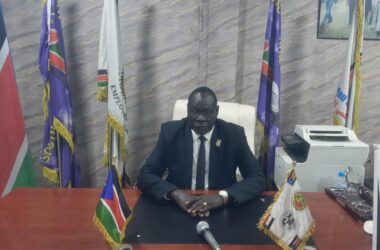
Speaking at a press briefing in Juba on Thursday, Minister Rizik Zachariah Hassan outlined plans to fill hundreds of vacancies, close legal and policy gaps across transport directorates, tighten freight management at the Port of Mombasa, and pursue major infrastructure feasibility studies with foreign partners.
“We have a lot of engagements in the upcoming few months,” Minister Rizik said.
The ministry revealed it is preparing to advertise and fill more than 400 staff vacancies across its directorates as part of an urgent push to professionalize the ministry, improve service delivery and implement new legal frameworks for sectors that currently lack governing laws.
“Despite the functionalities of these institutions, we still hold 400-plus vacancies,” the minister noted.
“We have established contact with the Ministry of Public Service, and an ad hoc committee is being formed to manage publications, shortlisting and interviews,” he added.
Minister Rizik said the recruitment would strengthen technical capacity in railways, air transport, road safety and pipelines directorates he described as operating “in a legal vacuum.”
“Out of six directorates, only two have laws. The Civil Aviation and River Transport,” he noted adding “The others including Railways, Road Safety, Air Transport and Pipelines still maintain legal gaps that we must address.”
A central plank of the reforms focuses on reducing trade and freight costs. The minister noted that South Sudan has long faced inflated import prices because of high container deposit and security fees at Mombasa, and a short “grace period” for returning empty containers.
“We realized there are disparities,” he explained following a recent meeting with Hassan Ali Joho Kenya’s Cabinet Secretary for the Ministry of Mining, Blue Economy and Maritime Affairs, which has oversight over the country’s ports and maritime sector.
“While Kenya charges about $1,000 and Uganda $1,500, South Sudan’s container security fees reached $5,000 plus border fee it reaches $6,000. These end up being added to prices that consumers have to pay,” the minister elaborated.
Following negotiations in Kenya, the minister said, Mombasa authorities have agreed to extend South Sudan’s grace period for returning empty containers from 14 days to 45 days.
“We raised the issue and the Kenyan authorities accepted our take. They have agreed to expand South Sudan’s grace period from 14 to 45 days,” he said.
He said the ministry is also pressing for a review of the container deposit charges and exploring ways to improve container tracking and returns.
The Ministry reported progress on streamlining freight handling arrangements as well. Minister Rizik revealed that a recent ministerial committee assessed five companies operating as Container Freight Stations (CFS) for South Sudan business in Mombasa.
“Out of five companies, two were found not to have presence in Mombasa, while another faced space challenges,” he said revealing that only two companies proved capable of handling South Sudanese freight for now.
Endorsing viable CFS operators, he said, would reduce delays, stacking and handling costs, and improve the timely return of empty containers; measures that would directly lower import costs.
Chairperson of the National Chamber of Commerce, Losidik Lokak Legge, welcomed the reforms stating that South Sudanese traders continue to face challenges with the current cargo transport system.
“Containers used to be brought straight from Mombasa to Juba, but now they are transported from Mombasa to Nairobi by train before being loaded onto lorries bound for Juba,” Lokak explained.
“This process adds extra costs, including $200 to unload from the trains and another $200 to reload onto trucks,” he added.
He noted that the Chamber has raised these concerns with the Transport Ministry, urging the government to streamline procedures and reduce unnecessary fees.
For long-term capacity and connectivity, Minister Rizik also touched based on the signing of a Memorandum of Understanding (MoU) with the China Roads and Bridges Corporation to conduct feasibility studies for the proposed Tali International Airport.
“We signed with the Chinese Roads and Bridges Corporation an MoU to carry out visibility studies for Tali International Airport,” he said.
He said technical teams from China are expected in Juba within two weeks to begin site visits and soil sampling, in coordination with the Civil Aviation Directorate. “This project, once realized, will be a strategic gateway for South Sudan,” he added.
The ministry’s broad initiative has been welcomed in principle, though its success will depend on consistent implementation.
A 2022 Diagnostic Trade Integration Study (DTIS) and other policy reports have long highlighted how logistics bottlenecks, road insecurity, and inconsistent regulations inflate trade costs.
The ministry’s package combining staffing and legal reforms, port-cost negotiations, endorsement of viable freight handlers, and feasibility studies for major airports is seen as ambitious but potentially transformative.
“If implemented, these reforms will strengthen our ministry, reduce costs, and open professional job opportunities for South Sudanese,” Minister Rizik said.
“But we must work together with our sister ministries, local governments, and partners to make it happen,” he concluded.