


By Alan Clement
South Sudanese agricultural experts warn that delays in finalising and enforcing the national seed policy expose farmers to counterfeit seeds, high costs and worsening climate shocks, undermining efforts to secure food independence.
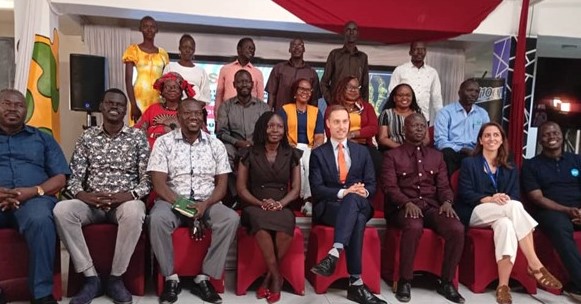
Speaking on Tuesday at the University of Juba during the closeout event of the A3SEED project, industry representatives stressed that a functional regulatory framework is the only way to protect farmers and stabilise the seed market.
Francis Ayiga, Chairperson of the Seed Traders’ Association of South Sudan, said the country’s seed prices remain high partly because production operates in an unregulated environment that allows substandard seeds to circulate, weakening farmer confidence and inflating costs.
“Pricing is a complex issue; but if you look at the history, the prices have been very high, which we acknowledge,” Ayiga said.
He explained that through the A3SEED programme, seed producers were trained on proper cost calculations, resulting in gradual price reductions.
“Over the five years, it has been reducing the unit cost of what we produce whether maize, sorghum or any other crop,” he noted.
Ayiga added that high-yielding varieties such as hybrids may appear expensive per unit but offer significantly higher output, making them cheaper in practice.
“When you’re producing a high-yielding product, the unit price may appear much, but when you look at the output, it’s actually less,” he said.
“Farmers actually have money. Once they attach value to what you are producing, you’ll pay for that to be able to get what you want,” he added.
He acknowledged that South Sudan remains “a bit expensive compared to neighbouring countries,” but insisted that local producers are now using proper pricing structures to gradually bring down costs.
Fellow expert Marial Makur Zachariah, Researcher at the Ministry of Agriculture and Food Security, warned that counterfeit seeds continue to be one of the most dangerous threats facing farmers, threatening national food production and distorting the seed market.
“All these things are actually driven by policy,” he said.
“If there’s a policy in place, those bringing counterfeit seeds will be held accountable according to the law. But if there’s no regulation, those things don’t go as they are supposed to be.”
He urged authorities and partners to fast-track the long-pending national seed policy, stressing that the lack of a strong legal and regulatory framework has slowed agricultural transformation.
“The negligence in law and regulations should be fast-tracked,” he added.
Makur also highlighted the growing threat of climate change to local seed production, calling for increased investment in strengthening and distributing varieties that withstand flooding and erratic weather patterns.
Drawing on research presented at the event, he said several indigenous varieties already show flood resistance and should be promoted in highly vulnerable regions.
He added that South Sudan’s research institutions are working to improve local varieties but require stronger financial support.
“If there’s good funding, we can work on improving local varieties to ensure they are resistant to climate changes,” he said.
South Sudan continues to import the majority of its seeds, leaving farmers vulnerable to high prices, inconsistent supply and counterfeit products.
Poor seed quality has contributed to low yields, persistent food deficits and heavy reliance on humanitarian assistance.
A national seed law would establish certification standards, regulate distribution, penalise counterfeit seed dealers, support local seed companies and promote climate-resilient varieties; critical reforms experts said the government must accelerate.
The A3SEED project, implemented over the past five years by IFDC and KIT with funding from the Kingdom of the Netherlands, has attempted to strengthen local production systems, but stakeholders insist that lasting change depends on firm government action.
As the project concludes, experts warn that without an enforced seed policy, South Sudan risks remaining trapped in low productivity, market distortion and worsening food insecurity despite its vast agricultural potential.