

By Chol D. Johnson
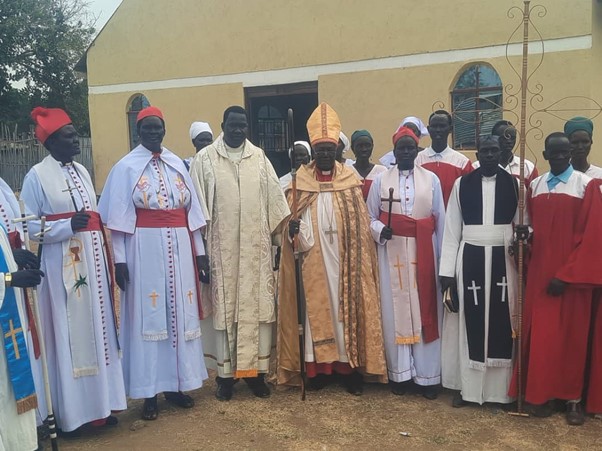
The Archbishop of the Anglican Church of South Sudan (ACSS), the Most Rev. Peter Bol Arok, has urged the government to urgently address the persistent cash shortage in commercial banks.
He warned that the continuous cash shortages in banks worsened the suffering of the citizens and the public across the country
Speaking on Thursday during Christmas prayers at St. Joseph Cathedral Church in Juba, Archbishop Bol described the situation as unacceptable, noting that depositors are unable to access their own money at a time when families need cash to meet basic needs.
“It is a shame that all banks in South Sudan are experiencing cash shortages. This is not something common in other countries; it is happening only here,” Archbishop Bol said.
He emphasized that citizens are not demanding handouts from the government but simply want access to money they earned through hard work.
“We know the government does not give us money. But the money we struggled for and deposited in our bank accounts should be available for withdrawal when we need it,” he said.
The archbishop also linked the banking crisis to broader economic and security challenges, arguing that insecurity continues to limit people’s ability to work, farm, and generate income that could contribute to national revenue through taxation.
“The problem is insecurity, which denies citizens opportunities to work or engage in agriculture, earn money, and pay taxes,” Bol said.
He added that the government’s capacity to pay salaries is largely limited to civil servants and organized forces, leaving many citizens dependent on savings they cannot access.
Archbishop Bol called on citizens to collectively raise their concerns with the government and seek accountability over funds held in banks.
“We must ask the government about our money deposited in the banks and whether it is responsible for ensuring its availability,” he urged.
He warned that the cash shortage has direct humanitarian consequences, with some families unable to buy food despite having money in their accounts.
“Some people are hungry because their money is in the bank and there is no cash to withdraw to feed their children,” he said.
Beyond economic concerns, Archbishop Bol appealed to South Sudanese communities to promote peace, unity, and shared national goals, cautioning that administrative fragmentation is deepening divisions.
He criticized the creation of new payams and bomas, along with the installation of new traditional chiefs, describing the process as harmful to social cohesion.
“These actions are creating division instead of strengthening relationships among communities,” he said.
Echoing these concerns, Jonglei State Minister of Local Government and Law Enforcement, Peter Kuer Atem, said the proliferation of new administrative units is distracting communities and placing additional financial burdens on citizens.
“Many people celebrate the creation of new bomas and payams, but in reality, it affects their living standards,” Kuer said.
He noted that the government currently lacks funds, and that much of the revenue generated through taxes comes from money sent by South Sudanese in the diaspora to support celebrations and administrative processes.
“There is no money from the government. The funds being taxed come from contributions sent by your sons and daughters in the diaspora,” he said.
Kuer questioned the sustainability of the initiative, arguing that it is unethical for a single county to have more than 60 traditional chiefs.
He further revealed that many newly created payams and bomas are largely uninhabited, as communities have been displaced by conflict.
“Most community members are internally displaced in neighboring states such as Lakes and Central Equatoria, while others are refugees in Uganda and Kenya,” Kuer said.
Meanwhile, Mayen Deng, a community leader from Twic East County, said he welcomed the Christmas season and expressed hope for resettlement.
“Life in urban centers is difficult. I am ready to return home if conditions allow,” Deng said, urging the government to pay salaries to enable people to afford transportation back to their areas of origin.
The cash shortage in South Sudan’s banking sector has persisted for months, compounding economic hardship amid high inflation, insecurity, and limited public confidence in financial institutions.