


By Alan Clement
South Sudan’s government has signaled a possible resolution to a 3-year land dispute that forced Christ Church Nakasongola to worship by the roadside, following renewed engagement with parliament officials, church leaders said Wednesday.
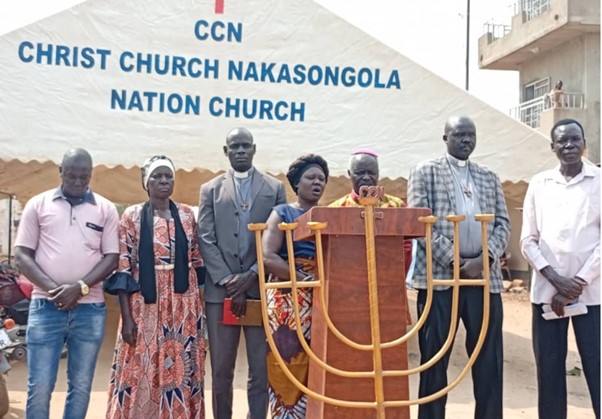
Senior leaders of Christ Church Nakasongola told a press conference in Juba that authorities had contacted the church and expressed willingness to restore the disputed land, marking what the church described as a significant shift in one of the capital’s longest-running church–state property disputes.
The land in question, according to church officials, has been contested between the church and parliament for more than two decades, leaving the congregation without access to its original compound and forcing worshippers to erect and dismantle tents weekly along a public road.
Bishop Charles Ladu, caretaker of Christ Church Nakasongola and General Overseer of the Foursquare Gospel Church, said the church had received assurances that dialogue would be pursued alongside ongoing legal processes.
“We have been praying here for three years under these conditions, and before that for many years on the road because of this dispute,” Bishop Ladu told journalists. “Now the government has called us, and we are ready for dialogue. If it is the will of God that we take this path, we accept it,” he added.
Church officials said the Speaker of the National Legislative Assembly, Jemma Nunu Kumba, had played a key role in opening space for dialogue, citing her recent public statements on reducing burdens on citizens.
According to the church, the Speaker has delegated First Deputy Speaker Lomin to lead the dialogue process between parliament and the church, a move seen as formalizing engagement at a senior institutional level.
“The Speaker delegated the First Deputy Speaker to lead the dialogue, and we are looking forward to it,” Reverend Abraham Marual, the church’s General Advisor, told the press conference.
The church said it has conducted prayers along the roadside for nearly 3 years, citing repeated displacement linked to the land dispute.
Reverend Mike Kenyi said the physical and financial burden of operating from a temporary roadside location had been heavy.
“Every day we have to lift this tent. It is heavy, and this is one of the burdens we are carrying. The church is on the road,” Kenyi said.
Kenyi added that the church believed parliament and the government had begun to recognize the hardship faced by worshippers, particularly following remarks by Speaker Nunu Kumba, who publicly stated she did not want additional burdens placed on citizens.
He further said discussions would involve legal representatives from both sides, with a focus on documentation, compensation, and possible restoration of the land.
“When the speaker called us, we made it clear that court processes are still underway and that everything must be documented,” he said. “We proposed that our lawyer sit with the government lawyer to discuss and come up with a list of items that need to be compensated,” he continued.
Church leaders said they were hopeful that the land issue could be resolved as early as January 2026, allowing the congregation to return to its original compound.
“We believe that in this coming January, we will be back in our previous compound,” Marual said, adding, “The government has remembered the suffering of the church and the believers.”
Despite the conciliatory tone, church officials emphasized that legal proceedings related to the land dispute have not been abandoned. Instead, they described dialogue as a parallel track to the courts.
“Wherever they call us, we will come and negotiate,” Bishop Ladu said. “But we have also said clearly that our lawyers must be involved, and everything must be documented,” he stressed.
The church did not publicly disclose the full legal history of the case or whether any court rulings had been issued in the past, but framed the dispute as one rooted in institutional misunderstanding rather than personal conflict.
In a notable departure from confrontational advocacy often seen in land disputes in South Sudan, Christ Church Nakasongola repeatedly stressed that it does not view the government as an adversary.
“We are not speaking against any person or even our government,” Bishop Ladu said, adding that, “The church and the government are one.”
The church said it had chosen restraint and dialogue over protest, even as it continues to operate under difficult conditions.
“Whatever has happened, it has happened,” Bishop Ladu said. “That is the work of the devil to destroy and to kill. But God sent Jesus to make peace.”
Church leaders used the press conference to call for broader respect for church property and religious institutions, arguing that the resolution of the Nakasongola dispute could set an important precedent.
“We are calling on the government to respect the property of the church,” Marual said. “God is above every government, and government follows God.”
Kenyi added that the church’s appeal had attracted international prayer support from believers in Africa, Europe, Israel, and the United States.
“We believe God is answering our prayers. We pray that our land will be restored so that God may continue to be worshipped in this nation,” Kenyi said.
The dispute highlights broader issues of land governance and institutional accountability in South Sudan, where overlapping claims between state institutions, communities, and religious bodies are common.
If resolved through dialogue and legal settlement, the Nakasongola case could serve as a test of the government’s commitment to addressing long-standing property disputes without escalation.
For the church, leaders said the outcome is about more than land.
“As we go into 2026, we want to go with new hearts. A heart that can restore what was taken and allow us to live together in peace,” Marual concluded.
In addition to addressing the land dispute, Christ Church Nakasongola also conveyed its condolences to the Eye Radio family and the wider media fraternity for the passing of journalist Emmanuel Akile on Tuesday, describing his death as a loss to the nation’s media community.