

By Jacob Onuha Nelson
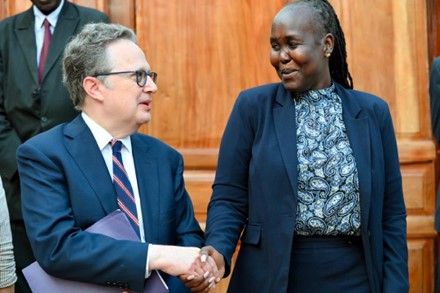
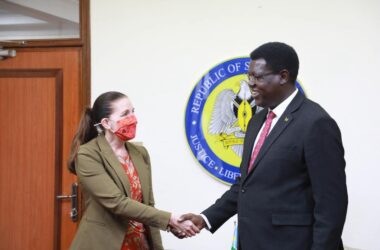
The Minister of Trade and Industry, Atong Kuol Manyang and the United States Ambassador to South Sudan, Michael J. Adler has pledged to maintain an open dialogue to foster a more resilient and transparent economic environment in the country.
This followed a high-level meeting held between the minister and a delegation from the United States to discuss strengthening bilateral relations and fostering.
In a statement issued by the ministry’s Press Unit, the discussion focussed basically on deepening economic ties between the United States and South Sudan with a specific emphasis on advancing business reforms to attract foreign investment.
“The U.S ambassador highlighted on peace and stability with emphasis to stabilize environment as primary prerequisite for American businesses to commence operations and invest in South Sudan” the statement partly read.
On Peace and Stability, the U.S. Ambassador emphasized that a stable and peaceful environment is the primary prerequisite for American businesses to commence operations and invest in South Sudan.
Adler expressed a concern regarding the security of humanitarian assets, citing recent incidents in Jonglei State where US vehicles were looted and destroyed.
The delegation underscored the need for continued dialogue on revenue utilization, specifically ensuring that national resources are effectively managed to prioritize the payment of civil servant.
In her response, Minister Atong, expressed her gratitude for the delegation visit and U.S continued engagement in South Sudan challenges.
She acknowledged the regrettable damage of U.S. humanitarian aid, assuring the delegation that the government is actively working hand in hand to improve the security conditions across the Country.
Atong called upon the International Community to support the Economy, empower the private sector and financial inclusion.
The Minister also presented a roadmap for the Ministry’s pending projects, calling for international support to diversify the economy, reduce reliance on oil by strengthening the non-oil sector.
“Empower the Private Sector by Supporting Micro, Small, and Medium Enterprises (MSMEs) and Financial Inclusion by increasing access to financial services and building institutional capacity,” the statement partly read.
The meeting concluded with a mutual commitment to maintain an open dialogue to foster a more resilient and transparent economic environment in South Sudan.
South Sudan’s economy is in severe distress, that is characterized by high corruption, debt, and limited reforms.
These resulted in a reliance on f oreign aid, with the U.S. being the largest humanitarian donor.
Bilateral ties with the U.S. had worsened due to mismanagement of funds, obstruction of aid, and lack of democratic progress in South Sudan.