


By Alan Clement
Northern Bahr El Ghazal’s State Legislative Assembly has approved a SSP 40.5 billion budget for 2025/2026, prioritising civil servant salaries and government operations, now awaiting the Governor’s assent to become law.
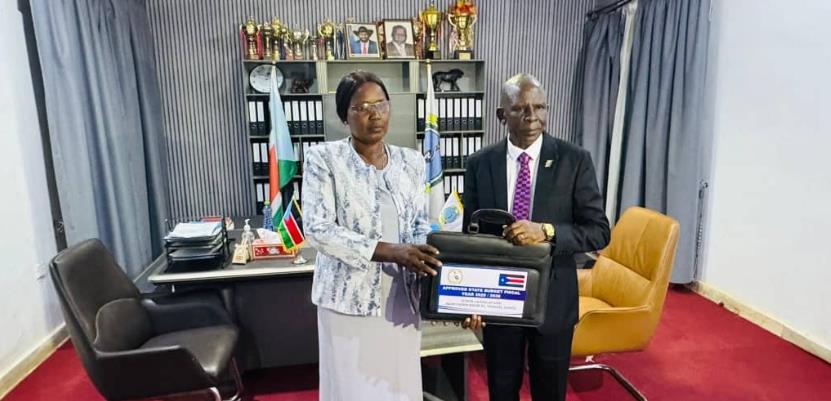
In a statement from the State’s press unit, the Speaker of the Assembly, Rt. Hon. Abuk Jiel Dhieu, formally presented the approved budget to the Governor, accompanied by the Assembly’s leadership, including the Majority Chief Whip and chairpersons of specialized committees.
The presentation marked the final step in the legislative process, enabling the executive branch to implement the allocations across government ministries and agencies.
Legislators and officials noted that the prioritisation of salaries reflects ongoing fiscal pressures on the State, where delayed wage payments have previously affected civil servants’ livelihoods and disrupted service delivery.
“Ensuring that government employees are paid on time is essential to maintaining stability and continuity of services across the State,” stated officials.
The approved budget outlines allocations for the operational costs of ministries, local government offices, and public institutions, alongside provisions for infrastructure maintenance, procurement, and program implementation.
Officials stressed that balancing these expenditures against limited revenue streams has remained a challenge, with the State continuing to rely on both internally generated funds and transfers from the national government.
Civil servant salaries have historically accounted for a significant portion of the State’s recurrent expenditure.
In the current budget, legislators said, priority is given to ensure that all staff across ministries, departments, and agencies receive their wages without interruption, while also maintaining essential administrative and operational functions.
The FY 2025/2026 budget also includes provisions for capital and development expenditures, but officials emphasised that operational costs, including wages, remain the most immediate priority.
Ministries are expected to manage development activities within the remaining allocations, while ensuring that core services are uninterrupted.
The State government has faced mounting pressure to improve financial management and strengthen accountability mechanisms, especially in the wake of past fiscal shortfalls that resulted in delayed payments and service disruptions.
Lawmakers said the current budget reflects lessons learned from previous years and aims to stabilise the State’s financial operations.
Officials underscored that the budget’s passage comes amid broader national discussions on fiscal responsibility, service delivery, and economic recovery.
By focusing on salary payments and operational costs, the State government aims to safeguard core administrative functions while gradually implementing broader development objectives.
With the Governor’s assent, the FY 2025/2026 budget will go into effect immediately, allowing ministries, departments, and agencies to begin executing approved allocations.
Officials emphasised that timely implementation will be critical to maintaining public confidence and ensuring that essential services reach citizens across the State.