

By Alan Clement
South Sudan’s government has formally acknowledged the long-term psychological, social and family costs borne by veterans and wounded soldiers, with senior officials pledging renewed attention to their welfare beyond battlefield injuries.
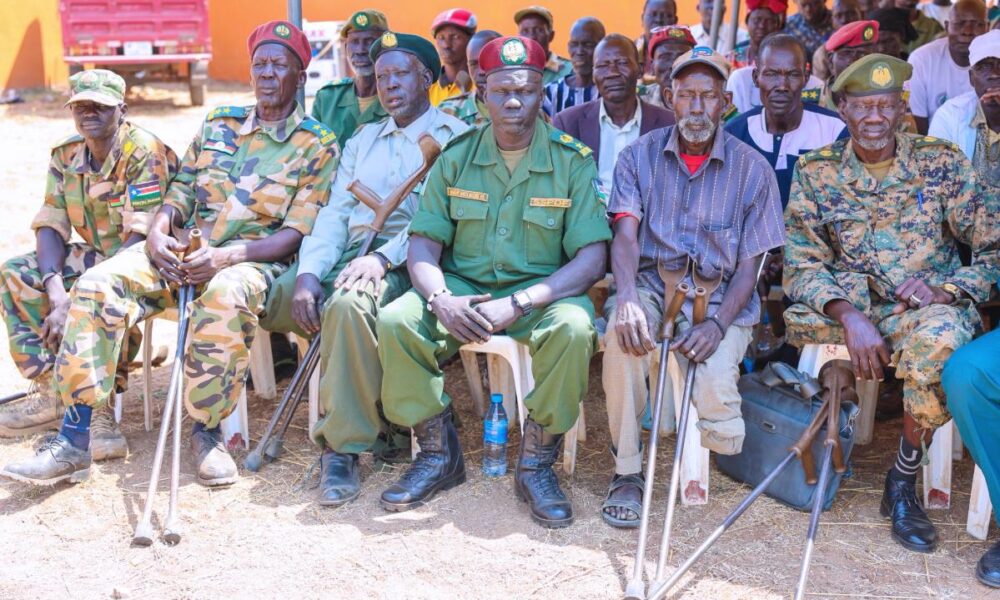
According to a statement from the Special Envoy’s office, addressing veterans in Bilpham on Wednesday, the Senior Presidential Envoy on Special Programs, Adut Salva Kiir, said the nation must confront not only the visible wounds of war but also the “unseen sacrifices” endured by those who served on the frontlines.
“I am here to interact with you, not to simply receive papers or documents, but to listen and to recognize the sacrifices you made. Sacrifices beyond the uniform,” Adut told an assembly of veterans and wounded soldiers.
The Presidential Envoy noted that many former combatants had paid a heavy personal price for the country’s independence and stability, including prolonged separation from families, lost opportunities to raise their children, psychological trauma and lasting physical injuries.
“Some of you spent years away from your homes. You missed watching your children grow. Others carry wounds. Some you can see and others you cannot,” she said adding, “These are sacrifices the nation must never overlook.”
The remarks marked a notable shift from ceremonial recognition of veterans to an explicit acknowledgment of the broader social and mental health impacts of conflict, an area long raised by former soldiers but rarely addressed in policy terms.
Hon. Adut stressed that protecting the dignity of veterans and wounded soldiers was a national responsibility, calling for stronger programs and sustained institutional support rather than ad-hoc assistance.
“This is not a one-day visit,” she said. “It marks the beginning of continued support. Maintaining your dignity and addressing your needs is a responsibility that belongs to all of us as a nation.”
The Envoy noted that her office is working to translate presidential commitments into practical interventions, particularly for families affected by war.
As part of that effort, she announced that 200 additional scholarships would be reserved specifically for children of wounded soldiers under a new scholarship initiative directed by President Salva Kiir.
The new allocation will be added to the 1,300 scholarships already earmarked for children from vulnerable families, a move intended to ease the long-term social impact of conflict on military households.
“With the upcoming launch of this initiative, we are ensuring that the children of those who were wounded defending this country are not left behind,” Adut said.
Recognition of psychological trauma and family hardship was as important as material assistance as many former soldiers struggle with reintegration after years of service.
The event was attended by Lieutenant General Chol Thon Balok, Minister of Defense and Veteran Affairs, alongside senior military and government officials, signalling high-level backing for renewed engagement with veterans’ issues.
While the government did not outline timelines or funding mechanisms for expanded rehabilitation and mental health programs, the public acknowledgment of “visible and unseen wounds” could increase pressure for more comprehensive veterans’ policies, including counselling services, social reintegration support and healthcare access.
South Sudan emerged from decades of armed struggle with tens of thousands of former fighters, many of whom continue to face economic hardship and limited access to services.
How governments address veterans’ welfare has implications not only for social stability but also for civil–military relations in post-conflict societies.
Officials said further consultations with veterans’ groups are expected as part of the Envoy’s continued engagement.