

By Alan Clement
The United Nations Mission in South Sudan (UNMISS) has warned that deep budget cuts and persistent restrictions on its movement are undermining civilian protection at a time when women and girls face some of the highest levels of violence globally.
Briefing the UN Security Council, UNMISS Police Commissioner Meinolf Schlotmann said the Mission is being forced to “do less with less” as funding reductions and delayed reimbursements to troop- and police-contributing countries strain operations.
He added that administrative impediments imposed by national authorities are further weakening UNMISS’s ability to respond rapidly to violence and protect vulnerable communities.
“Timely access saves lives,” he stressed, adding that obstruction prevents UN Police (UNPOL) from reaching communities where women are at acute risk of sexual and physical violence.
“Recurrent constraints on UNMISS movement significantly undermine mandated tasks,” Schlotmann told the Council noting that more than 65 per cent of women and girls in the country have experienced physical and/or sexual violence in their lifetime; among the highest recorded rates worldwide.
“Within this volatile political and security environment, UNPOL’s approach is to protect today, while helping build a police service that can protect tomorrow,” Schlotmann told the Council, stressing that current constraints are eroding that balance.
Under the Status of Forces Agreement (SOFA), UNMISS is guaranteed freedom of movement across South Sudan. Yet Schlotmann reported that patrols continue to face denials of access, delays, and restrictions on the use of UN bases as operational hubs.
These impediments, he said, are particularly damaging during the rainy season when roads and bridges are impassable, making air mobility essential.
“The Council has previously called on the authorities to cease obstructing UNMISS and to respect its ability to use all bases,” Schlotmann reminded who added that, “Without unhindered ground and air movement, our capacity to protect civilians, facilitate humanitarian action, and respond to gender based violence is severely compromised.”
South Sudan has among the highest recorded levels of gender based violence globally. Rigorous studies indicate that more than two thirds of women have suffered physical or sexual violence in their lifetime.
Conflict related sexual violence remains widespread, with women and girls targeted during intercommunal clashes, displacement, and insecurity around protection sites.
Schlotmann emphasized that UNPOL is prioritizing survivor centered policing, expanding women led community policing platforms, and reinforcing specialized investigation and referral pathways with national counterparts. “We are helping build capacities related to survivor centered policing and reinforcing specialized investigation and referral pathways with the South Sudanese National Police Service,” he said.
He added that women officers are essential to effective protection and response. “Hiring freezes and uncertainty around allowances for uniformed personnel hamper our ability to attract and retain special police expertise, including the women officers essential to effective protection and SGBV response,” Schlotmann cautioned.
UNMISS is operating under a mandated 15 per cent budget reduction, which has translated into an estimated 33 per cent reduction in uniformed and civilian personnel across the Mission. For UN Police (UNPOL), the impact has been immediate and operational.
“Closures and consolidations of field locations, with associated staff reductions, stretch our ability to maintain consistent community engagement in hotspot areas,” Schlotmann explained.
“Even before current constraints, UNMISS could not be everywhere at once. Now, we must do less with less,” he added.
As part of cost-cutting measures, UNMISS has reduced its physical footprint, including the closure of some field offices. The field office in Aweil was closed at the end of December 2025, with other locations consolidated. While the Mission continues to patrol from nearby bases, the changes have limited sustained community engagement in high-risk areas.
“Even before current constraints, UNMISS could not be everywhere at once,” Schlotmann said, pointing to South Sudan’s vast size, poor road infrastructure and long periods of seasonal inaccessibility.
Despite the constraints, UNMISS Police said it is adjusting its approach to preserve life-saving effects. UNPOL has concentrated Individual Police Officer (IPO) patrols in geo-referenced hotspots identified through mission-wide early-warning systems and humanitarian access indicators.
To institutionalize surge capacity, UNPOL is proposing the piloting of “Rapid Deployment FPUs” with police contributing countries, enabling short notice deployments into high risk locations alongside IPOs.
“These capabilities would complement; not replace essential fixed presences in various field locations,” Schlotmann clarified.
UNPOL is also concentrating IPO patrolling in geo referenced hotspots prioritized by mission wide early warning indicators and humanitarian access needs.
Rotational deployments to company and temporary operating bases sustain community engagement, mediation, and patrols in areas where offices have closed. In parallel, UNPOL is advancing a consolidated capacity-building agenda with the South Sudanese National Police Service to strengthen sustainable national policing.
UNPOL is set to assist the South Sudan National Police Service with command and control, crowd management, evidence-based operations, and measures to curb rumor and hate speech–driven violence.
South Sudan, nearly twice the size of Germany, faces poor road networks, seasonal isolation, and political volatility that spills across borders, disrupting humanitarian corridors.
By linking government obstruction of UNMISS operations to the inability to respond to gender based violence, Schlottmann’s briefing underscored the intersection of political accountability and human impact.
For regional audiences, the message is clear: restrictions on peacekeepers are not abstract bureaucratic disputes but life and death issues for women and girls across South Sudan.
Schlotmann reiterated that peacekeeping remains critical in South Sudan. While the 2018 Revitalized Peace Agreement raised hopes of a post conflict trajectory, today’s realities demand decisive protection of civilians alongside enabling national institutions to shoulder their responsibilities.
“UNPOL in UNMISS will continue to be field centric, mobile, and integrated; protecting communities, facilitating humanitarian action, supporting peace process deliverables, and advancing professional, accountable policing,” he affirmed.
The Commissioner’s warning places renewed pressure on South Sudanese authorities to honor their obligations under the Status of Forces Agreement and to allow UNMISS unrestricted movement.
Without such compliance, the mission’s ability to respond to one of the gravest gender based violence crises in the world will remain severely constrained.
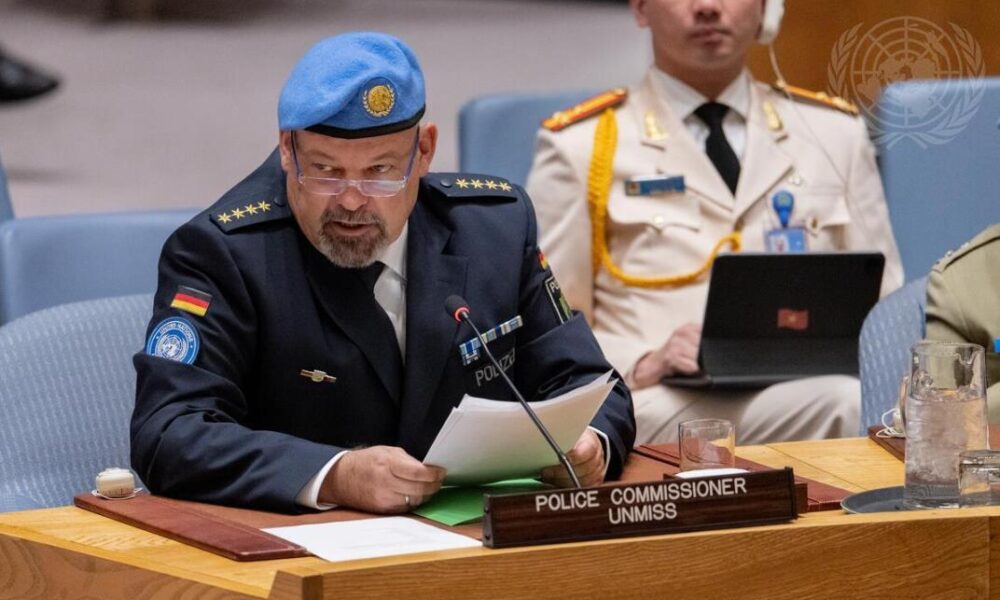
Gov’t Obstruction Undermines Protection of Women Amid GBV Crisis: Warned UNPOL
More in National:
-
 Climate Shocks, Weak Governance Push Women into Water Crisis
March 23, 2026
Climate Shocks, Weak Governance Push Women into Water Crisis
March 23, 2026
-
 VP Taban claims officials obstruct access to President
March 23, 2026
VP Taban claims officials obstruct access to President
March 23, 2026
-
 Residents urge gov’t to construct drainage after floodwater incident
March 20, 2026
Residents urge gov’t to construct drainage after floodwater incident
March 20, 2026