

By Alan Clement
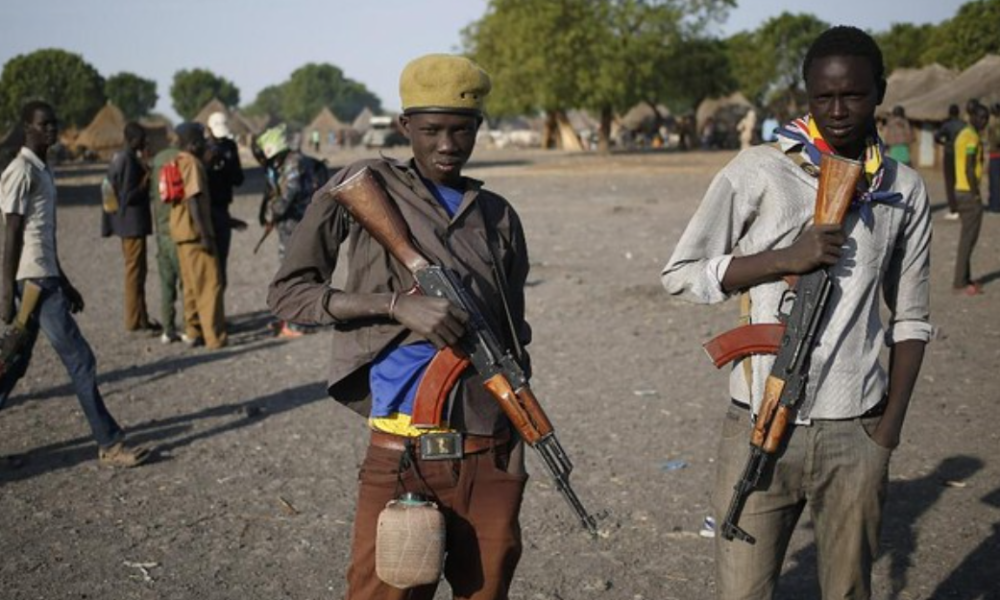
Gun violence in South Sudan has shifted decisively toward criminality, killing over a thousand people in 2025 and leaving civilians increasingly exposed as firearms become entrenched in everyday life, a new report has found.
The findings contained in the Gun Violence Report released by the One Citizen Network for Democracy (OCND) paint a picture of a country where insecurity is no longer defined solely by organised armed conflict following an analysis of 218 gun violence incidents recorded nationwide between January and December 2025.
According to the report, of the 1475 killed in 2025 alone, 1,365 of those killed were men, 71 were women, and 39 were children, underscoring the disproportionate impact of gun violence on civilians despite the formal existence of a peace agreement.
The OCND report noted that violence became increasingly decentralised and normalised, with firearms frequently used in criminal acts, personal disputes, and accidental incidents far removed from traditional frontlines.
Between July and December 2025 alone, OCND documented 104 gun violence incidents that resulted in 598 deaths and 480 injuries with civilians accounting for 318 of those killed, surpassing the 278 soldiers who died during the same period.
The report further noted that two foreign nationals were among the fatalities. Civilians were similarly overrepresented among the injured, with 251 civilian injuries compared to 229 involving soldiers or other military personnel.
The data reveal a marked transformation in the nature of violence. Criminal activity and gangsterism emerged as the leading driver, accounting for 37.5 per cent of incidents during the second half of the year.
Politically motivated and military-related violence followed at 26 per cent, while ethnically motivated attacks made up 10.6 per cent. A further 14.4 per cent of incidents were linked to accidental shootings and negligence, highlighting unsafe weapons handling and weak regulation of small arms.
“These findings show that South Sudan is no longer facing violence only from organised armed conflict, but from a dangerous normalisation of gun use in daily life,” stressed OCND.
“Weapons are increasingly used to resolve minor disputes, commit crimes, or are mishandled in ways that lead to preventable deaths,” OCND added in a statement.
OCND noted that many incidents occurred during routine civilian activities, including travel along major roads, farming, social gatherings, and business transactions in markets and trading centres.
Armed robberies, targeted killings, and revenge attacks were widely reported, often escalating rapidly due to the easy availability of firearms and the absence of effective local conflict-resolution mechanisms.
Although men made up 89.1 per cent of fatalities between July and December 2025, the report stressed that women and children were not spared. Dozens of women and children were killed or injured, reflecting what OCND described as the erosion of civilian protection across the country.
Several deaths were linked to accidental explosions involving grenades or improperly stored firearms, underscoring the risks posed by widespread weapons circulation in civilian spaces.
Geographically, gun violence was recorded across all 10 states and the three administrative areas of South Sudan, demonstrating the national scale of the problem.
Western Equatoria recorded the highest proportion of incidents at 14.4 per cent, followed closely by Central Equatoria at 13.5 per cent, Jonglei at 12.5 per cent, and Lakes State at 11.5 per cent.
Other states and administrative areas, including Upper Nile, Warrap, Unity, Abyei, Pibor, and Ruweng, also reported multiple incidents, indicating that no part of the country has been immune.
The report further highlighted the fragmented nature of perpetrators involved in gun violence. Individual attackers were identified as the most frequent perpetrators, accounting for 28.8 per cent of incidents, followed by armed youth at 26.9 per cent and rebel groups at 25 per cent.
Government forces and militias accounted for the remaining incidents, pointing to a complex and overlapping security landscape.
“The most frequently identified perpetrators were individual attackers, armed youth, and rebel groups,” OCND stated adding, “This diversity of actors points to a fragmented security environment with blurred lines between political, criminal, and communal violence.”
OCND situates the surge in gun violence within South Sudan’s protracted conflict cycle dating back to the outbreak of civil war in December 2013 and the persistent failure to fully implement the 2018 R-ARCSS.
While the peace deal reduced large-scale hostilities, core provisions related to security sector reform, arms control, accountability, and elections remain largely unfulfilled.
Delayed unification of forces, repeated postponement of elections, and weak rule of law have, according to the report, allowed small arms to proliferate and violence to diffuse into civilian life.
As a result, gun violence has become increasingly detached from formal battlefields, threatening humanitarian access, economic recovery, and long-term stability.
OCND warned that without urgent action, South Sudan risks entrenching a cycle of criminalised armed violence that could undermine both peace and governance.
The organisation urged national and state authorities, working alongside international partners, to prioritise dialogue and local conflict resolution, strengthen civilian protection and community policing, enforce accountability and the rule of law, and regulate the possession and use of small arms.
“Without parallel investments in public safety, justice, and livelihoods, South Sudan risks entrenching a cycle of criminalised armed violence that will undermine peace, recovery, and humanitarian access,” OCND concluded.