



By Kei Emmanuel Duku
In the dust-filled traditional dance camps in Terekeka County of Central Equatoria, the pursuit of love is a high-stakes endurance test where a single slip can cost a man a bull. The Mundari people are preserving an ancient social fabric through the Gelle—a fast-paced traditional dance that serves as a living matrimonial agency for unmarried youth, where physical strength and a clean family reputation are the only currencies that matter.
The Gelle is a specialized performance primarily practiced by the people of Thali and Tindilo payams. Unlike the Diki, which is a somber farewell staged on the final day of a burial to alert the community that a prominent person is no more, the Gelle is a vibrant celebration of life and lineage. It is here that young women, ready for marriage, spot their potential fiancés and begin friendships that lead to formal introductions.
“This Gelle dance is performed by people who are not married,” explains Bush Buse, a youth representative from Terekeka County. “They spin around, running, singing. And the married ones in the middle, they clap, they give morale. There are those who are beating the drums. This is where ladies spot their life partners. They get notice, and they begin to make friendship.”
The ritual is a grueling display of stamina. Before the drums even begin, dancers must eat heavily to sustain the energy required to run at high speeds for up to 40 minutes without tiring. In the village, away from the soft carpets of the town, the intensity is raw. Men and women demonstrate their strength to be worthy of the titles “man” or “woman,” moving in a circle on the tips of their toes.
The mechanics of the dance are intimate and protective. John Garang, a youth from Tali Payam, describes the hold as a boy grasping a lady from her back, his hands extending between her waist and chest while she holds him on opposite parts of his body.
This support is vital to ensure neither partner falls during the high-speed rotations. However, the selection process is strictly in the hands of the women.
“The gentlemen line up and the ladies will select,” Buse says. “If you are not selected, it is a bad luck for you. Maybe you don’t look nice or you don’t have good behaviors. Maybe you are coming from a bad family with a bad background. No lady wants to go with an ugly man or somebody who has bad behaviors.”
The stakes for the men are high. If a gentleman allows a lady to fall from his hands, it is viewed as a sign of irresponsibility and a lack of strength to provide during times of famine. Such negligence attracts an immediate fine of one bull paid to the lady’s parents.
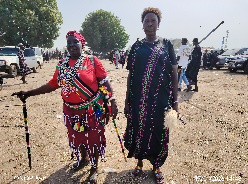
Christina Khemisa, the Chairperson of the Gelle dance, explains that the dance is governed by strict rules. Dancers are arranged by height—the shortest in front and the tallest behind—to avoid collisions. To distinguish between participants, married women wear red clothes and are forbidden from dancing with youth, while single girls wear beads and leave their breasts halfway covered.
“It is shame, why would you allow a girl to fall off your hands?” Khemisa asks. “There will be charge for this; either you immediately marry the lady or you will be fined by paying a bull. You hold her tight on the stomach so that if she wants to fall, you will be able to support and lift her up.”
If a couple accidentally hits an object and both fall, they are disqualified the following day by a panel of experts, often becoming the subject of mocking songs composed by other youths.
The Mundari remain committed to promoting positive attributes such as respect, traditional dances, and the dyeing of hair with cow urine. For those who find a partner during the Gelle, the dance is only the beginning.
“At the end of the dance, partners embark on detailed introduction and exchange of contacts,” Garang says. “From this stage, marriage negotiations start on how many numbers of cows the parents will demand. If the boy cannot afford the required number, he will still be given the girl as his wife but will be tasked to look after the remaining numbers and take them to the parent.”