

By Alan Clement
Renewed fighting in Jonglei State is straining African Union-backed peace efforts, raising fresh concerns over ceasefire compliance and exposing the fragility of South Sudan’s already protracted peace process.
Addressing South Africa’s Parliament of Thursday, the country’s special envoy to South Sudan, Paul Mashatile, said the latest clashes underscore “the complexity of the search for peace,” despite sustained regional mediation under the African Union (AU) and the Intergovernmental Authority on Development (IGAD).
Mashatile, speaking in his capacity as envoy of President Cyril Ramaphosa, said South Africa alongside the AU and IGAD remains a guarantor of the Revitalised Agreement on the Resolution of the Conflict in South Sudan (R-ARCSS).
He stressed that implementation ultimately depends on the political will of South Sudanese leaders.
“The peace process in South Sudan depends on the political will of its leaders for the implementation of the revitalised agreement. Our role is to support them and not substitute their responsibility,” he said.
His remarks come amid fighting that erupted in January among rival forces and has since intensified displacing civilians in Jonglei State.
The renewed violence has cast doubt on the durability of ceasefire arrangements and raised fears of a broader relapse into instability.
Regional efforts to contain the situation have been spearheaded by the AU’s so-called C-5 bloc comprising South Africa, Algeria, Chad, Nigeria, and Rwanda which was established by the AU Peace and Security Council in 2014 to support peace initiatives in South Sudan.
The bloc has consistently called for cessation of hostilities, the release of detainees, and the promotion of inclusive political dialogue.
Mashatile revealed that a ministerial delegation from the C-5 countries visited Juba in January, followed by a heads-of-state summit in February chaired by President Ramaphosa on the margins of the AU Summit.
The meeting, attended by representatives of the UN Secretary-General, reiterated demands for an immediate ceasefire and broader political engagement among the parties.
Despite these efforts, the resurgence of violence highlights persistent gaps in implementation of the 2018 revitalised peace agreement, which formally ended a five-year civil war that killed an estimated 400,000 people and displaced millions.
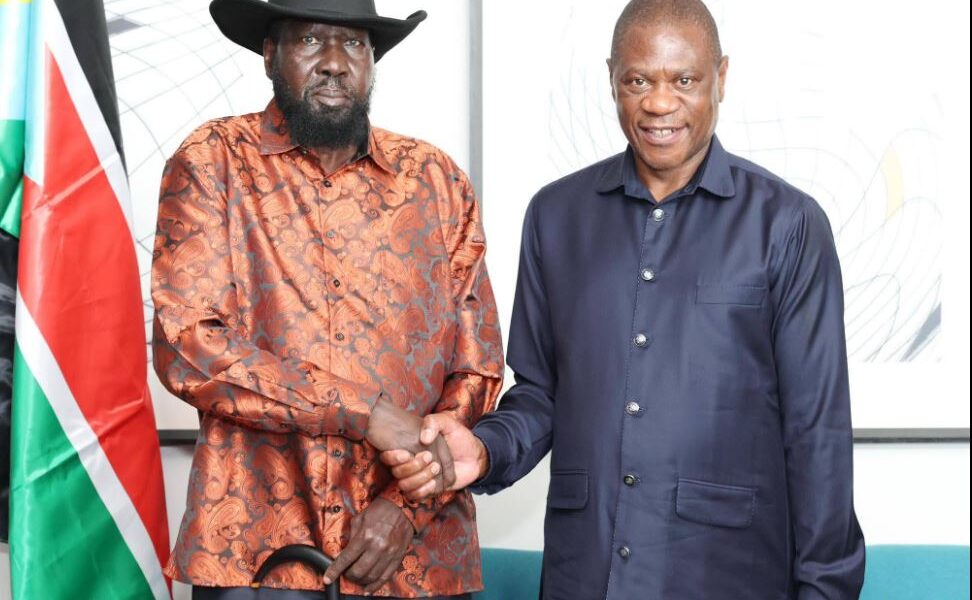
Mashatile noted that during his previous engagements in Juba, including two working visits where he met President Salva Kiir Mayardit and other stakeholders, there had been cautious optimism about progress.
However, the latest clashes have reversed those gains and reinforced concerns about the volatility of the security situation.
The envoy also disclosed that regional leaders have continued to push for confidence-building measures, including the release of detained political figures such as First Vice President Riek Machar, and the creation of conditions conducive for inclusive dialogue.
Beyond security concerns, Mashatile pointed to a worsening humanitarian situation, compounded by the spillover effects of the ongoing conflict in neighboring Sudan.
He said South Africa is engaging international partners, including the International Committee of the Red Cross, to coordinate responses to growing needs across the region.
The AU Peace and Security Council is expected to play a more active role in mobilizing diplomatic, technical, and financial support, with South Africa set to assume a position on the council from April through 2028.
The renewed violence in Jonglei serves as a stark reminder that while regional mechanisms remain critical, their effectiveness is increasingly being tested by the failure of South Sudan’s leaders to fully implement agreed reforms and uphold ceasefire commitments.
As clashes persist, the gap between diplomatic assurances and realities on the ground continues to widen, placing further strain on AU-led efforts to stabilize the country and prevent a return to full-scale conflict.