

By Sabri Dibaco
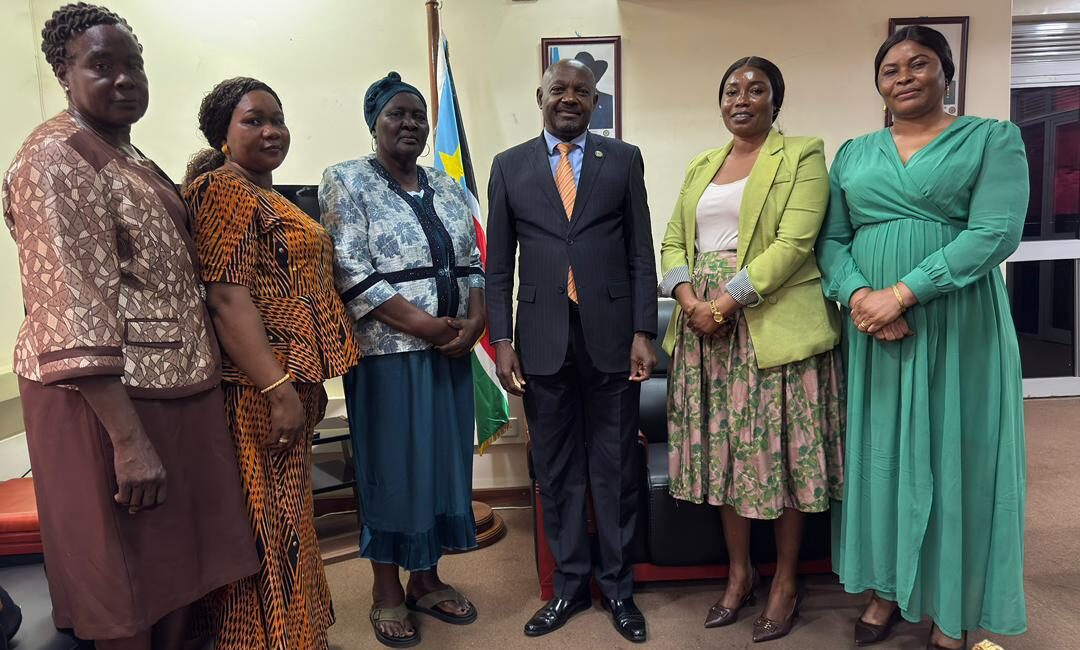
The Minister of Agriculture and Food Security, Clement Juma, held separate engagements with women parliamentary cocoa representatives from the Transitional National Legislative Assembly and the ambassador of Russia, focusing on strengthening agriculture, food security, and international cooperation.
The women’s parliamentary delegation representing Western Equatoria State visited the minister to congratulate him on his recent appointment and discuss support for women farmers, land access, cooperative societies, and security in farming communities.
In an exclusive interview, Viola Samuel Satti, the TNLA, representing WES, said that the discussions centered on empowering women and organising agricultural cooperatives across the country.
“We have discussed how the ministry will really work in the interest of the nation and, in particular, also support women, empower them, and organise the cooperative groups that are available here in South Sudan,” Satti said.
The delegation also emphasised the importance of land access and security for agricultural production.
“We also talked about the issue of the land because we know agriculture; without land, there is no agriculture,” Satti stated.
She further highlighted the challenges farmers face due to insecurity and poor infrastructure.
“Our people are suffering. They cannot cultivate in a big number. People are practising subsistence agriculture that is only for consumption in their homes,” Satti added.
The lawmakers urged the ministry to champion peace and security in farming areas to enable communities to return to large-scale cultivation.
Clement Juma, the Minister of Agriculture and Food Security, on his part, reaffirmed the ministry’s commitment to increasing food production and reducing dependence on imported food. He stressed the importance of agriculture as the backbone of the national economy and encouraged citizens to actively engage in farming.
Juma said that the ministry plans to work closely with cooperative societies across the country and revive agricultural institutions to strengthen production and productivity.
He also revealed plans for the ministry to visit national agricultural projects and collaborate with partners to improve feeder roads connecting farmers to markets.
Meanwhile, the ministry also hosted the ambassador of the Russian Federation to discuss bilateral cooperation in agriculture, including technology transfer, training, food input supply, and value addition.
The Russian ambassador, Aleksander, expressed readiness to support South Sudan’s agricultural development through technical cooperation and investment.
“We want to help South Sudan in the sphere of agriculture. We can share our technologies and our product with our South Sudanese brothers,” the ambassador said.
He added that Russia was prepared to deepen collaboration with South Sudan in the agriculture sector.
The undersecretary for food security, Robbert Michael, in the Ministry of Agriculture and Food Security, described the meeting as an important step toward strengthening relations between the two countries.
“The Russian Federation will be able to support us to improve the productivity and the production of our farmers in the Republic of South Sudan,” Robbert Michael said.
The discussions are expected to lead to further technical engagements and the development of a memorandum of understanding to formalise agricultural cooperation between South Sudan and Russia.